
CARAVAN TO MIDNIGHT: SPYMASTER OF MONTE CARLO
Last Night's Radio Show with John B. Wells

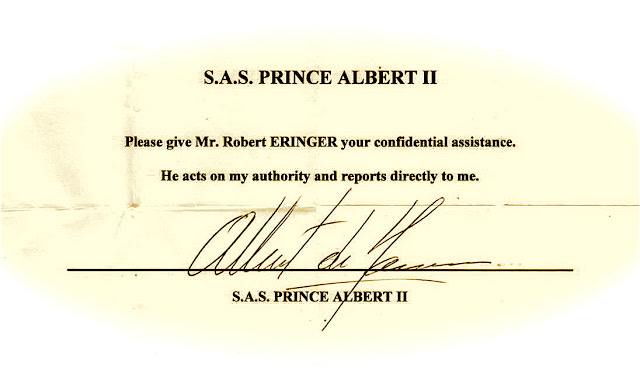
JW: Over the course of his career, Robert Eringer has conducted undercover operations as a journalist and private sector intelligence professional, working in coordination with U.S. counterintelligence efforts in Moscow, Havana, and beyond. His assignments included cultivating relationships with high-profile intelligence targets and assisting in operationsinvolving international fugitives as well as Cold War defectors.
While advising Monaco, he established liaison relationships with major intelligence services including CIA, MI6, France’sDST, Italy’s ISISMI and founded a cooperative intelligence association among several European micro-states known as the Columbus Group.
Mr. Eringer writes regularly on intelligence, geopolitics, and corruption through his Substack platform and is the author of multiple books, including Ruse: Undercover with FBI Counterintelligence, and his forthcoming release, Spymaster of Monte Carlo, a first-hand account of palace politics, espionage, and the inner workings of power inside one of the world’s most glamorous and secretive sovereign states.
Tonight, we speak with a man who has operated inside royal courts and intelligence corridors and who now pulls back the curtain on how power truly protects itself.
Without further ado, we welcome to the program for the first time, Robert Eringer.
Thanks for being here tonight, sir. It’s a pleasure and a privilege to speak with you tonight.
RE: Thank you for having me, John.Where shall we begin?
JW: How did you, an American intelligence operative, first meet Prince Albert all the way back to 2002?
RE: I first moved over to Monaco at the end of the 1980s, and at that time I was not involved in intelligence. My background is in investigative journalism, and I’d recently become a literary agent, representing authors, mostly Washington insiders I was young then, and I thought I’d go to Monaco for a little bit of adventure and fancied the idea of scouting new literary talent. In the course of living there for a couple years, I met Prince Albert several times. I moved away from Monaco, back to Washington D.C. in 1990, and partnered up with Clair George, who had just retired as a Deputy Director of Operations for the Central Intelligence Agency. We decided to go into private-sector intelligence together, and—tongue-in-cheek—decided we look into things for royalty or billionaires. Lo and behold, within a few months, that’s exactly what we were doing.
A couple months later, it evolved into me undertaking undercover missions for FBI Counterintelligence, and I did that for about the next nine years. When that came to an end, well, meanwhile, I’d continually gone back to Monaco, partly for the private sector intelligence work, and partly because I kept a home there for a while. I would meet Prince Albert, and we would talk about what we were both doing. And when my missions for the FBI came to an end, he asked me if I would do intelligence for him.
Albert had a major concern about the Russian surge into the French Riviera, and wondered how much that applied to Monaco, and wanted me to find out for him. In addition to that, he was concerned about all the various people from everywhere, all over the world, who wanted to be part of his social orbit, and he felt that, just lately, back in 2001-2002, there were a number of possibly unsavory characters trying to penetrate his social orbit. He wanted to know more about them before he allowed such persons to enter his orbit, which is why he retained me to be his intelligence advisor, at his own expense, not the expense of Monaco in June 2002.
It’s an important distinction, because back then, Albert was still the hereditary prince. His father,Prince Rainier III, was still the monarch, and for whatever reason, Albert was kept in the dark about all kinds of things that were going on, and that’s why he hired me. I mean, you’d think that the French who were pledged to protect Monaco would have been briefing him on affairs of state, and also on the foreign travel that he took to all parts of the world to visit with foreign leaders, but they never did, and his father didn’t include him either, probably because his father was very ill at that point, and in fact wasn’t running Monaco, the people around him were running him and Monaco.
So Albert had some very deep-seated reasons for needing intelligence, and that’s why he retained me.
JW: Well, what in your opinion convinced him that he needed this? I mean, this must have been based on his sensing a threat environment. Was it just general coverage, or was there something specific that sort of moved him to do this?
RE: Nobody was telling him anything in the government, and I think it was probably his good friends who thought that he needed it, because one of his closest friends was one of my friends, and that’s why Albert came around to thinking that yes, perhaps it was a good idea.
JW: Okay, gotcha. So after Prince Rainier’s death, how did the transition of power change your role and expand the intelligence structure you were building?
RE: Well, all of a sudden I was able to escalate from “intelligence advisor” to creating for him what we then called the Monaco Intelligence Service, and it allowed me to expand my relationships with foreign intelligence services. Up until that point, I had cultivated liaison relations with CIA and with Britain’s MI6. They understood that Albert would one day rule his country. They understood that Monaco had a lot of issues, especially with regard to a Russian surge and money laundering, and they were willing to assist us. And after April 2005, when Albert ascended the throne, I was then given the green light to expand these intelligence service liaison relationships to a point where I eventually cultivated 20 relationships with foreign intelligence services, all of which were at 48 hours’ notice willing to send someone from their service to Monaco to brief both Prince Albert and me on whatever Prince Albert wanted to know about.
JW: Gotcha. So, this question almost answers itself. I mean, I think you’ve answered a good bit of it already, but what do you actually have to do? What does it mean to build an intelligence service from scratch inside a sovereign micro-state? You’ve got personnel, all different kinds of priorities and methods of operation.
RE: So I guess the short question really is, what does it actually mean to build an intelligence service from scratch? And it’s a great question. I already had a number of connections into intelligence with regard to undercover work I did for the FBI all through the 1990s. In addition to that, I had a network of operatives that Clair George and I had cultivated doing private-sector intelligence work all through the 1990s.
So when it came to creating an intelligence service for Prince Albert of Monaco, I already had established a number of good contacts, former CIA operatives who had retired, computer dataveillants, a spectrum of specialists who I could call upon for specific tasks. But the most important thing for me, because I was operating on a very small budget, was to be able to collect intelligence at no cost, which was the very deep rationale for creating liaison relationships to foreign intelligence services, who would provide us with the intelligence we needed at no cost. And essentially, once I had those elements in place, within a year of starting off, I had created for Albert a very cool, streamlined intelligence service that produced for him very, very good results.
JW: Wow. Amazing. It really is. So, I don’t know why I’m tempted to ask this question, but I can’t resist temptation. Who did you find to be the easiest to work with? CIA, MI6, [French] DST, or the Italians?
RE: My favorite intelligence service to work with was the Luxembourg service. And I saw them as a model for what we would have liked to have become in Monaco, and should have become if things worked out in a positive way.
I found the CIA more of a hindrance than a help in the long run. There were things they assistedus with, but I found them very unprofessional over the years. FBI was not very helpful at all. Even though I had a long-term relationship with them doing undercover counterintelligence operations, maybe they were suspicious of what I was doing in Monaco. Certainly they weren’t as supportive as they should have been, and could have been.
JW: And DST?
RE: The DST doesn’t actually exist anymore. Back then, it was France’s internal security service the way MI5 is an internal security service in Britain. They and another French organization called the RG later put together and a whole new name was created for them.
JW: Yeah. Interesting. What about MI6? What was it like having a liaison with MI6?
RE: Very professional. I found them to be one of the most professional of all. We had briefers who would come to see us in London who were very forthcoming with substantial information especially compared tothe CIA, and very, very polished. I would consider MI6 to be one of the best intelligence organizations in the world.
JW: You know, in this gig here, Robert, you’re going to bump into some people in the spook world every once in a while. So many of them have really described CIA. I’ve heard this at least three times something like man, that bunch they’re just a bunch of cowboys.
RE: I’m not sure I’d call them cowboys. I would call them over-bureaucratized and to a point where they’ve been bureaucratically inept. And other intelligence agencies, friendly intelligence agencies around the world, look at them as a wallet. They love the money they can get from the CIA to do what they need to do. But I don’t, like I said, I did not find much professionalism dealing with them.
JW: Really? That’s disappointing. Not altogether surprising considering they had John Brennan. And I never miss an opportunity to mention that he voted for Gus Hall, the communist candidate in the presidential election in 1976. He was given a speech one time and said so even though I voted for Gus Hall, the communist candidate in 76, even things like that will not stand between you and a career at CIA. And I thought, wow, I wonder what the limit really is. You know?
RE: Fortunately, John Brennan was not part of our equation because he was not director until later. We had the good fortune of working with Porter Goss, who had been chairman of the House Intelligence Committee and who arrived and understood what we were doing and was extremely supportive of it to a point where a Goss Doctrine was created to protect Monaco. I liked him very much. I met him and I organized for Prince Albert to be briefed at CIA headquarters in Langley. We met Porter Goss at that meeting and thereafter we were very substantially briefed by some very senior officials. The problem was there was no follow-through after that event because, unfortunately, CIA is so bureaucratically organized that everything had to go through their Paris station chief. He was the weakest link in the chain. We called him “Lips” because all he did was pay lip service, and all he cared about was reporting back to Langley every month or two that everything was just fine even when everything wasn’t just fine. He was a horse’s ass, in my opinion, and because he was in Paris, the whole relationship with the CIA was skewed.
JW: Oh. Yeah, it only takes one, doesn’t it? In a key position?
RE: I mentioned earlier that we had a very positive relationship with MI6. In fact, it was Christopher Steele, later of the whole Hillary Clinton thing, the Steele Dossier,who came to Monaco. Christopher Steele, whatever he became later, when he was at MI6 he was very polished, very professional. He provided the most amazing briefing to Prince Albert and myself on Putin and Russia.
JW: Amazing.
RE: Yes, it was, but it would have been nice if Albert had actually listened. Unfortunately, most of the time, he was too bored by the intelligence briefings we were given. Instead, he had his mind on whatever his next date would have been because he was more interested in sexual escapades than he was in affairs of state.
JW: So, I wonder why he wanted you to build this intelligence service from the ground up .
RE: In fact, when he first ascended the throne and a few months later had the ceremony that officiated that, he announced a “new ethic” in Monaco. He was going to clean up the principality and rid it of money laundering and corruption. And it was great to hear that because by that time, I’d been working for him for over two years and building up my files on all the corrupt people in Monaco or who wanted to come in Monaco who were engaged in money laundering. And I thought, great. Now that he is the monarch, we’re going to start cleaning things up.
And then what happened? Nothing much. Part of the problem, as I mentioned, is he’s not that interested in affairs of state. At least he wasn’t back then. And he didn’t know what to do. He has no backbone for leadership. And he kept putting it off and putting it off and putting it off. As he claimed at the time, he was going through a six-month mourning period, which is traditional in Monaco. So what he was doing was, hanging out most of the time at the family farm at Roc-Agel in the French Alps just behind Monaco and doing things like importing sand to build a volleyball court. That’s what he was doing instead of focusing on who was going to be his chef de cabinet, French for chief of staff. Now, earlier I had pointed out to him that his finance minister, who had been groomed for the job of chief of staff, was terribly corrupt. And he should not under any circumstances appoint him his chief of staff. One of the rare cases where Albert listened and didn’t do that. Instead, he asked me to vet another Monegasque, a Monegasque who was then living in Paris in a very good job. I did so.He passed the vetting. He was appointed. He was gung-ho. He was amazing. He was ready to implement the program that Albert had brought me in to put together. That is, all the dossiers, all the files of all the people who needed to be cracked down on, how the government ministers should have been changed. There should have been a zero-based review where everybody resigns and he starts from scratch. And this man came in, understood from me what needed to be done, and started to do it. Well, of course, everybody around Albert rebelled. The ministers, the palace courtiers, the people he grew up with who were shocked and horrified by this because as they pointed out to Albert, you don’t get it—this is how we make our money. We’re a very corrupt state, a very corrupt country, and you can’t crack down on this. This is everybody’s bread and butter. So, the knives came out. Not for me, initially, because they didn’t know who I was. For the first few years, I was completely invisible, and nobody even knew Albert had an intelligence advisor and then an intelligence service. But, the chief of staff became their main target because they saw him as the guy who was helping Albert implement a program that Albert said he wanted implemented. Well, we can’t have that.
JW: Wow. What’s the strategic importance of the little countries, Monaco specifically, that would incline the prince to need an intelligence service. Was he feeling some kind of heat? Was it some sort of a whim? I mean, why did he even want to do this?
RE: He thought it was a good idea at the time. He didn’t realize that that was how Monaco has been making its money for… forever, actually. Monaco is on the gray list, and they’re talking about putting it on the black list. Because although they have been promising for years to clean things up the way Albert originally said he was going to do it, it’s all talk, no action. This is part of the reason why I created an association of intelligence services from micro-European countries. What I discovered, to my astonishment, is there had been no meaningful contact between the micro-states of Europe, which is where all the confidential banking is, until I tried to set up an association. Luxembourg was the first country I went to. They have a very small, streamlined, very professional intelligence service, which I saw as a model for what we in Monaco should become. And together, we then brought other micro-states into our fold, and had quarterly meetings with them, the idea being that we would be a shield. Let me add something to the mix, though. Although all the micro-states in Europe get blamed for their money laundering, most of the real money laundering takes place in London and New York and Paris. They have been the true culprits, and essentially what we were saying back to the larger countries and their intelligence services, instead of blaming all the micro-states, clean up your own act, because we’re now going to start cleaning up ours, and we’re going to create a common shield among us. Up until the point where I created this, Monaco’s police were not in contact with theLuxembourg service or the Luxembourg police. Sure, there was Interpol, and there was an official relationship, but anytime anybody requested information on a suspected money launderer, it would take months for it to get processed through normal bureaucratic protocol. What I did, I cut through the red tape, and we got right to it. I’d go to San Marino, which is a tiny little micro-state surrounded by Italy, and suggest to them they join what we had established, and not only were they willing, they immediately brought out a file and said, “Can you please tell us about this Austrian guy, because he says that he’s got these bona fides from Monaco?” And within a day or two, we were able to report back to the San Marine's Financial Intelligence Unit. That’s all they had. They didn’t have a real intelligence service. They had a financial intelligence unit. We were able to report back that the guy was a fraud.And as a result of that, they banned him from investing into a San Marine's bank. That’s why the system we created was so wonderful. I think it kind of scared the bigger countries. They didn’t like what we were doing. They didn’t like the fact that the micro-European states were getting together and saying, look, it’s not all our fault. And in fact, we’re going to actually make an attempt to clean things up.
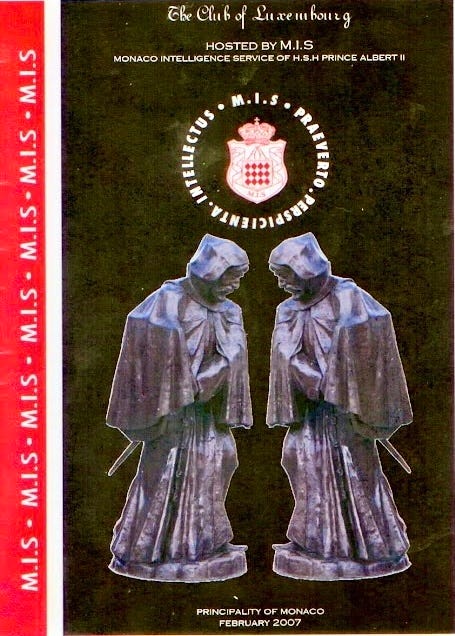
JW: Wow, that is something. And so you created this Columbus group among the European micro-states.
RE: I did. The assistance of the Luxembourgish were very supportive. I went to Luxembourg, told them my idea. They thought it was amazing. And all of a sudden, we had Lichtenstein involved, and they brought Malta in, and we got San Marino. Tried to get Andorra in, but it turned out they were so corrupt in Andorra. They didn’t want to know. Andorra is a little country in the Pyrenees between Spain and France. A principality, they call it, but it’s actually one large duty free shop. They didn’t want to know because all the ministers were corrupt. But what I discovered thereafter is, they were also corrupt in Monaco.
And when in Monaco, when the government ministers discovered what they were doing, they were pulling their hair out of their heads. They just wanted us to close shop and go away, and Albert not to have an intelligence service, so that they could carry on like they always have.
JW: There’s an interesting biblical parallel here about the rulers and principalities and so forth. You just named some principalities. These principalities, it appears, are where the real action happens. That’s what it looks like.
RE: Well, for the Russians, that’s where it was happening. Because what Russians, Ukrainians and others were interested in is being able to siphon money from the state in Russia and Ukraine. Corrupt ministers, corrupt businessmen, siphoning money all the time. They need somewhere to park it. And they need to launder it. So they park it in banks.
Through the 1990s, it was Switzerland. That was their favorite spot. But the Swiss caught on to them and said, enough. We’re expelling you. They didn’t fight back. They just said, alright, there’s other places we can go.
Monaco was one of them, and they went to Monaco. Despite my best efforts to convince Albert, well, remember I said that he was concerned about the Russian surge. And so we did our due diligence and discovered that he had good reason to be concerned, because Russian intelligence and Russian organized crime, which had become one and the same, had designs on Monaco, and they did want to come in there and occupy the place.
So Albert, through our efforts, was very well versed in this, or at least he pretended to be. Maybe it went in one ear, out the other. But pretty soon, Albert was allowing Putin and Russia to cultivate a relationship with him.
And the way that began is that Albert had been wanting to do an expedition to the North Pole, and it was the Russians who agreed to assist with that and help them with a launching spot. And once all that got organized, Putin invited Albert to a state dinner at the Kremlin, which took place once they returned from the North Pole. And there was a state dinner. And at that state dinner, Putin offered Albert a gift, a very expensive gift.
He offered Albert a whole house, a dacha, which is a traditional Russian summer home, a country home. And he offered to send builders from Russia, laborers, to travel to Monaco and build the dacha from scratch as a gift. Albert didn’t need the money, he’s said to be a billionaire, and I never found him to be personally greedy.
But nonetheless, he acquiesced and said, well, you can’t build it on the palace grounds where they wanted to, but you can build me a dacha if you want at our country farm in France. So, lo and behold, a group of Russian construction workers arrived and built him a dacha from scratch on the grounds of Roc Agel.
Well, you can imagine the place is probably wiredthrough the rafters.
JW: Absolutely!
RE: Wired up, and the whole point is kompromat. We just want to learn as much about this guy, his sexual habits, everything else, so we can leverage it against him when we need to, when that time comes.
But the larger issue here was Albert, at that time, and for years before that, and still, has a seat on the IOC committee, the International Olympic Committee. It is part of the IOC’s code of ethics that you are not allowed to accept gifts from countries that are bidding to have the summer or winter Olympics in their country.
Well, at that time, we’re talking about 2005 into 2006, Russia was in contention for the Winter Olympics of 2012, and they wanted to have them in Sochi. Well, Albert gets this gift from Putin, which is against the IOC’s code of ethics. They come and they build it.
Albert votes for Sochi, and that’s where they ended up having the Olympics in 2012.
So, at that point, to my thinking, Albert had become corrupt himself, even though he didn’t need the bread. He was not only complicit in the corruption, which he began to allow to continue, even though he knew who was corrupt in his government and who in his court and elsewhere in Monaco was corrupt, he did nothing about it, but he himself took a bribe against IOC rules.
JW:
But let me ask you this, and I’m just firing a shotgun out the back door. Did you pick up anything that had anything to do with Epstein while you were conducting your intelligence gathering where Monaco is concerned? In other words, did he have his hooks into that place too?
RE: Let me begin by responding to what you said about the micro-states. The bigger European countries use the micro-states as their back doors to do the dirty stuff, to arms dealing and maybe money laundering that may be governmental. France has Monaco, Spain has Andorra, Switzerland has Liechtenstein, and the UK has the Channel Islands.
So that deals with that. With regard to Epstein, I was not aware of Epstein during my tenure working for Prince Albert, which was 2002 until the end of 2007. He was never on my radar screen.
Trust me, we were really busy. We had so much other stuff to do. We were not aware of him.
You’re asking about Albert though? There’s nothing that I’ve been able to see so far in the Epstein files that connects Prince Albert of Monaco to Epstein. It intrigues me having learned about Epstein, thinking back to when I knew Albert, that his closest associate or rather even friend, certainly, his closest contact in the British royal family was then-Prince Andrew. It was most certainly because of mutual interests that they were able to establish a close bond.
When Albert would go to Britain, if he was going to see a royal, it would be Andrew. If Britain needed to send a royal over to Monaco, it was Andrew. They had a very friendly relationship based on what I would call common interests.
JW: I just wonder how close to the edge do most of these micro-states play? Are they pretty secure in what they’re doing or are they nervous about the associations they have? I guess the short question is, how do these systems protect themselves so well from external scrutiny?J
RE: Monaco is insulated and France probably approves quietly, secretly anyway, of Monaco being its back door for dirty dealings, arms dealings. Also, it seemed to me that France was quite happy having ministers in Monaco who were corrupt, who the French knew were corrupt, so that they could be leveraged.
It worked to their advantage. Just like when I discovered that Putin himself had secret stake in oil distribution companies based in Monaco and I made the French aware of it. They didn’t seem surprised, but they did seem a little alarmed that I discovered it because they would have preferred to hold that close to their chests and utilize that intelligence to get a better oil deal out of Gazprom, whereas they never really trusted me because even at the end, when my service to Prince Albert came to an end, when I ended it—because I just felt I wasn’t going to work for somebody who clearly wasn’t going to clean things up and he was going to be corrupt himself—they put the word out among other European intelligence services that I was the CIA station chief in Monaco. That was their way of discrediting me ultimately.
In fact, I was not the CIA station chief in Monaco. I had a liaison relationship with the CIA, but the French was able to use that and stretch it to make others think that I was a CIA guy running intelligence in Monaco. Even Monaco’s Minister of State believed that.
When he found out about my existence, he was livid and wanted to get rid of me and went to the chief of staff I was talking about and said, I know you’ve got a CIA guy running intelligence for you.
JW: So, take us back to the beginning, this association between you and the prince occurred, he reached out or you reached out?
RE: Oh, I guess it was a collaborative effort in that I would visit him and let him know what I was up to and what I call the information business, how it evolved from journalism into intelligence at a time when he wanted to be informed because his good friend felt it was a good idea and I was in. It happened on a very casual basis.
JW: This might be a little sophomoric, but I’ll try it anyway: It’s not that he was worried about stuff that was going on there that was going on under his nose. He was worried about it being detected which is why he wanted the intelligence apparatus set up in his country.
RE: He didn’t know enough to worry about anything being detected. That was the problem. He was not informed at all. He was just pointed in directions around the world to do stuff and kept in the dark.
JW: Back to that shotgun-out-the-back-door thing. These monarchies are, you know, obviously they’re different from democratic republics. Or constitutional republics, or whatever word salad anybody who’s doing any talking at the time comes up with to describe our United States of America here. But, so intelligence liaison relationships create cooperation, but they also establish quiet leverage between nations. What kind of leverage would that be in your experience? Between nations.
RE: I don’t think it’s been so much leverage, at least from my experience, it was a good thing, and it all came about after 9/11. Not only were American agencies cooperating with each other more than they ever had before. They were ordered to. But European and American intelligence agencies were cooperating with each other. The focus, of course, during those years was terrorism in the Middle East, fundamental Islam, almost to the detriment of all else. 95% of their resources went on that, and they cooperated very, very closely to deal with that threat.
But even friendly countries still spy on each other. That’s what they do.
In fact, intelligence services will even spy on their own leaders, whoever’s in the White House here, whoever’s at Downing Street, whoever’s at the Elysee Palace in Paris. Intelligence services collect intelligence. They want to know everything about everyone all the time.
And if they’re really good, they do know, because their collection process is good, and they’ve got good analysis as well.
JW: Interesting. So royal ecosystems, if we may call it such, is a blend of finance, politics, diplomacy, and intelligence, woven tightly into a protective circle.
RE: The micro-state principalities were at a disadvantage. Prince Albert and his father, Prince Rainier, were at a disadvantage because they had a structured government that didn’t tell them what they needed to know.
And that’s why it was so smart of Albert, without him even realizing it, to reach around the government and saying, I want unfiltered intelligence that’s reportable only to me. Because up until that point, I discovered, because Albert put me in touch with a couple of trusted members of the Monaco police to work with, and they were delighted. Why? Because for the first time, they believed their intelligence, which they considered very important, would finally reach the palace, would reach Albert.
Because without me, there was a protocol where anything that the police developed on anyone would have to go through the interior ministry. And they would filter what they wanted filtered, and they would tell the palace only what they wanted the palace to know. And when they discovered that Albert had his own intelligence service, they were mortified.
JW: Wow. What a dicey spot to be in.
RE: Well, you had to be there. It was pretty dicey for me, I can tell you. There’s nothing more cutthroat in the world than a royal court. Even more so than a presidency. Presidents and prime ministers come and go. But the royals are there to stay. And people in Monaco, and I’m sure it’s true in the other various principalities, it’s a forever game of who can brown their nose the deepest.
Everybody wants to be a friend of the prince. Everybody wants to be in his social orbit. I had a taste of this when Albert invited me to attend the Music Awards in Monte Carlo.
At a distance, I observed the dynamics of a royal court. It was really interesting how people who were not invited to sit next to Albert would try to come out from where they were seated and get closer anyway, so that others watching or taking photographs would perceive that they were closer to Prince Albert than they were meant to be. This is a game that’s constantly played.
In Monaco, and I imagine it’s true of all of the micro-states where there’s royalty, and in the UK as well, Everybody wants to know the prince, somebody in the royal family. I guess it’s good for their social status, existence.
That’s why royalty has been so enabled for so long to get away with the crap like Andrew was getting away with for a long time, and that Prince Albert also has been getting away with even now.
JW: That’s pretty heavy. So the big question is not scandal, but how these power structures respond when confronted with exposure. If you don’t mind, let’s just visit this thing that’s going on with the throne there in merry old England. Do you think this is going to blow over? I understand King Charles is not in the best of health at all. How do you think this is going to go for Andrew? He got arrested on his birthday and so forth. I guess the short question is, how will that, the monarchy is going to continue no matter what. So given this kind of exposure and this level of scandal, how do you see just based on your experience and just maybe some guesswork too, you’re probably pretty good at it. How’s the throne going to survive this? That’s the short question. Or is it even under threat?
RE: My opinion on the matter, and I’ve been following it closely, is that, as you point out, Prince Charles has not been in the best of health and it may be much worse than we’ve been let on. And Prince William’s popularity is very, very strong in Britain.
So it probably makes the most sense that the way that this evolves is that Prince Charles will not abdicate during the next few weeks or the next few months. But he won’t go on until his death like his mother, Queen Elizabeth II, did. He will, at some point, step away and give William the larger chance to lead at a younger age.
And also because they need a fresh start at this point.
So I suspect that’s where it’s going in Britain. And yes, I do think there’s more to come. They’re now talking about all kinds of files that Epstein squirreled away in storage units. Plus, I don’t think they’ve gotten to the bottom of everything that’s in the files yet. Those that have been released and those that some say still exist but they’ve not yet released.
There is more to come and I would hate to be in his shoes right now for somebody who is entitled and enabled as much as Andrew was. This is a massive come down.
RE: As for Monaco, I left Monaco at the end of 2007 and moved on. There are people who try to keep me tuned in and email me the latest of what’s going on. Aside from the fact that I finally wrote this book, because I think the true story needed to be told, Monaco is not the focus of my life.
But nonetheless, I watch with amusement as Albert continues to pretend to rule and yet is probably not in control at all. It’s people in dark corners who are stage managing the corruption that continues.
JW: That seems like that’s the problem here in the United States. Do you see it that way?
RE: No question. Trump is an activist president. Usually presidents go along with the process, the status quo, the process of pretending to keep things running the way budgets grow, bureaucracies grow, and they hire more people. Institutions like to increase their ability to be bigger and have more say and more money.
Trump stands in the way of that because he’s an outcome president. He’s an activist, like an activist judge who actually tries to do really important things when it comes to the law instead of just going along with the normal process. One thing Washington D.C. or any world capital can’t stand is an activist leader.
They want a leader who believes in process, which generally means, let us get on with everything. The system calls for it, unfortunately, because when anybody gets elected, start with Jimmy Carter, who everybody called an outsider, even though he wasn’t. He was brought in by the globalists, the Trilateral Commission that made him a member early on to try to promote their ideas.
But say somebody gets into the White House, it takes them two years just to figure out how Washington works, unless they’ve been in the Senate for 20 or 30 years and they have a better grasp of it. But for somebody like Jimmy Carter who comes in or Donald Trump, when he first came in, he didn’t really know how Washington works. And what happens is Washington knows that and goes, don’t worry, sir, we know how it works. We’ll take care of everything. And when a new president has big ideas and calls all the various institutions in and says, alright, here’s what I want to do, they give him all the reasons why he shouldn’t do that.
So that life can continue on as normal and everything gets processed the way it always has been and the way they always want it to continue to be processed.
JW: kings and queens don’t seem to be any more intelligent than the aforementioned special people and their special positions who don’t seem to be that intelligent either.
RE: They’re definitely not. They just got in their position because they were born into the family, so they didn’t have to prove anything. They’re just there. At least in this country, you’ve got to show some merit to get elected. You’d think, anyway. It’s hard to say that’s even true now, based on very many members of the Democrat party in right now. I look at them and I can’t believe that anybody would ever vote for them. That doesn’t make me a Republican by the way, because I consider myself an independent journalist and I try to be really objective, but it boggles my mind who gets elected in this country today.
It’s almost, to me, to my thinking when I see some of these people, I don’t know if you recall a movie called Idiocracy, but that’s what it looks like to me. It certainly looked like that to me when Biden was president.
JW: It certainly did. Back to this Columbus group among these European micro-states. Is it still functioning?
RE: Sadly, no. When I decided the time was up for me, because Albert was complicit in corruption, I wanted to go to Europe and say, guys, keep continuing, have your meetings. But then the French said I was the CIA station chief in Monaco and they all got scared, and as far as I know, they never regrouped again.
JW:: Wow. Your book, and anything else you may be putting out there? You’ve got a Substack?
RE: I do. I post almost every day. I break the rules of Substack. Instead of sticking to a niche subject, I’m all over the place, but that’s me. I write what I like. I speak my mind and I tell the truth.
JW: And how do we get your book? It’s available on Amazon and Barnes and Noble as a pre-order. Hopefully in bookstores once it’s published on March 19th.
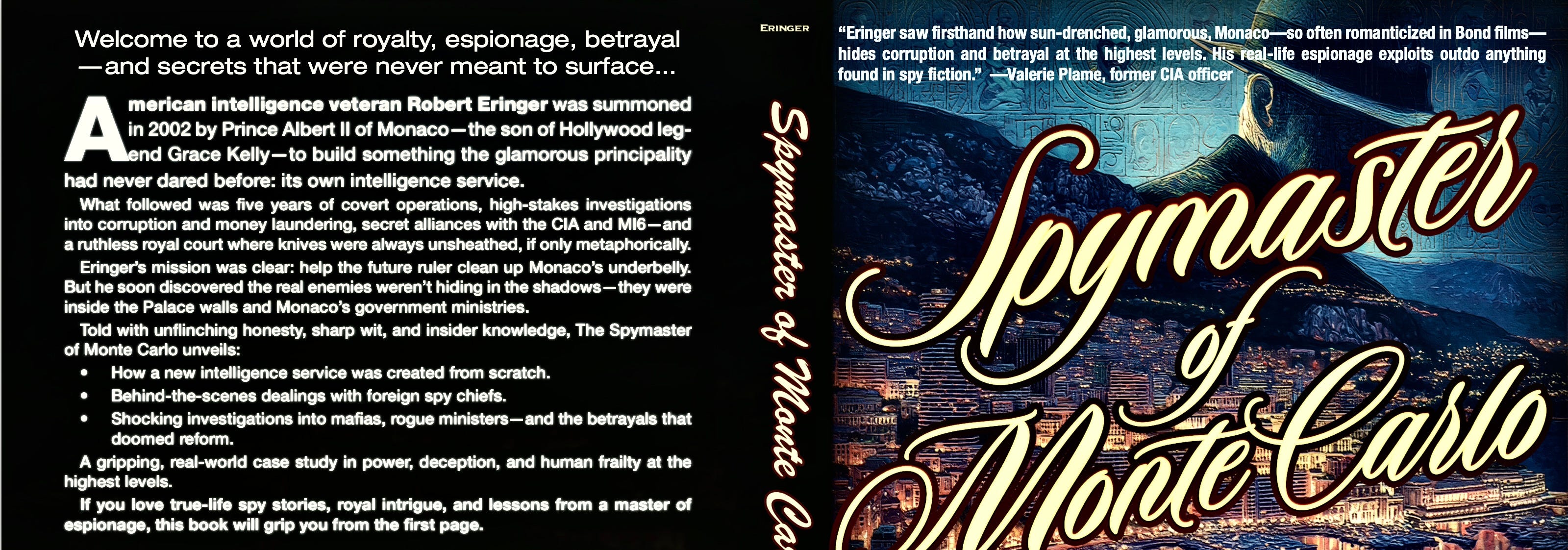

The Spymaster of Monte Carlo, Amazon
Publication: 19 March
Step inside the gilded world of Monaco—where breathtaking beauty masks a labyrinth of corruption, intrigue, and espionage.
In this electrifying true story, American Robert Eringer is summoned by Prince Albert II—son of Hollywood legend Grace Kelly—to create Monaco’s first-ever intelligence service.
Reporting directly to the prince, Eringer built an extraordinary operation: cultivating secret relationships with the CIA, MI6 and 18 other foreign intelligence services, and key figures on U.S. Senate and House intelligence committees.
He arranged meetings for Prince Albert with CIA Director Porter Goss and FBI Director Robert Mueller III.
He led operations targeting money-laundering networks, exposed mafia influence, and uncovered deep corruption at the highest levels of Monaco’s government.
But when the time came for action, Prince Albert’s courage faltered—and a promised “new ethic” for Monaco crumbled under the weight of old-world power plays.
Set against the dazzling backdrop of the French Riviera, Spymaster of Monte Carlo reveals how truth, loyalty, and power collide in the shadows behind a royal façade.