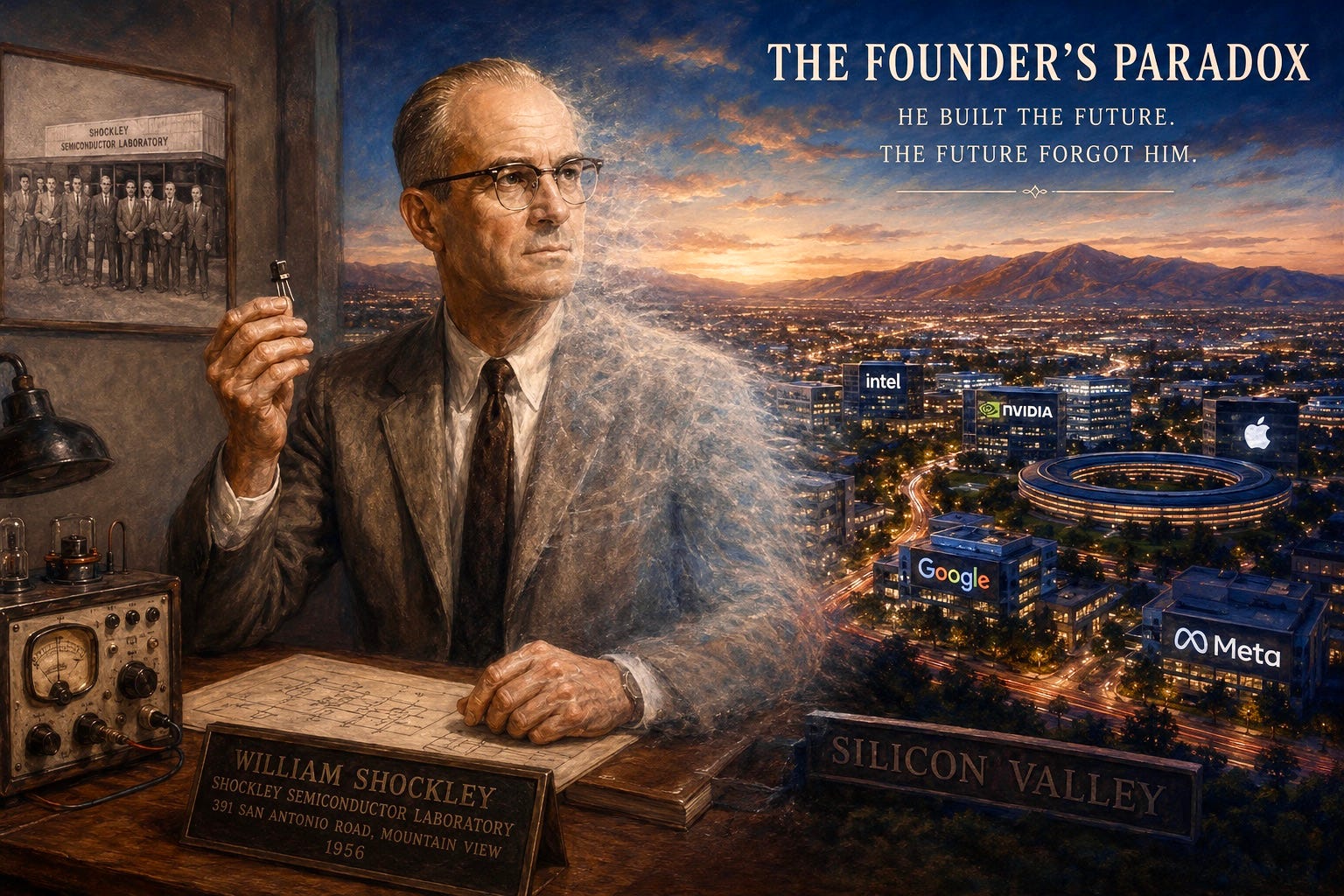
When people think of Silicon Valley’s founding fathers, they tend to picture Steve Jobs in a black turtleneck.
Or perhaps Hewlett.
Or maybe Packard.
Few think of William Shockley.
Yet if there is a single address that deserves to be called the birthplace of Silicon Valley, it is not the old Hewlett-Packard garage in Palo Alto, as I first believed.
It is 391 San Antonio Road, Mountain View.
Today, you can buy groceries nearby, grab a latte, or browse the shops at The Village at San Antonio Center.
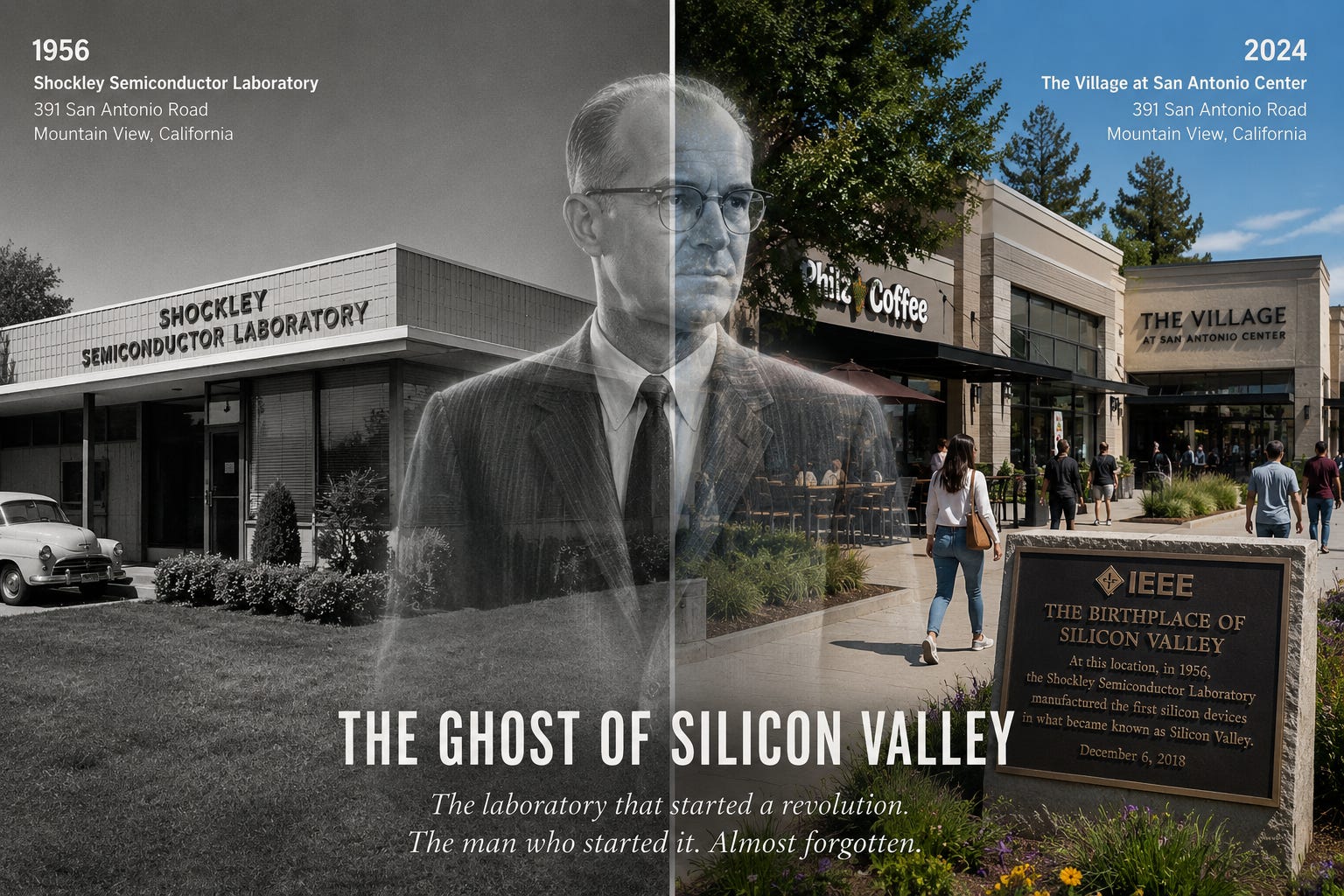
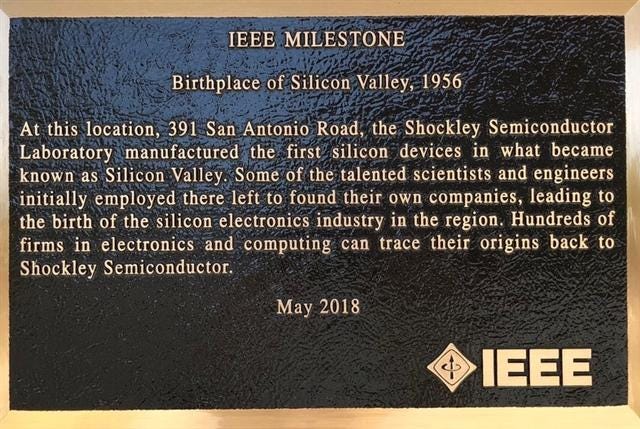
Only a simple bronze plaque marks the spot. Most pass without noticing.
Which is curious.
Because this is where Silicon Valley truly began.
Shockley was no ordinary scientist.
In 1956 he was already a Nobel laureate, having shared the Physics Prize with John Bardeen and Walter Brattain for the invention of the transistor at Bell Labs—a tiny device that would eventually make possible everything from pocket calculators to smartphones, spacecraft to artificial intelligence.
More importantly for California, Shockley believed the future belonged not to germanium—the semiconductor then in common use—but to silicon.
He established Shockley Semiconductor Laboratory in Mountain View, the first company devoted to manufacturing silicon semiconductor devices in what would soon become Silicon Valley.
In other words, he quite literally put the “silicon” into Silicon Valley.
Had events evolved differently, schoolchildren might visit the site the way tourists visit Palo Alto to honor Hewlett & Packard.
Instead, few even know it exists.
Here is the reason.
William Shockley was a brilliant physicist.
He was also—by almost every account—a terrible boss.
Suspicious. Controlling. Needlessly combative.
His management style inspired neither loyalty nor affection.
Within a year, eight of his brightest young scientists had seen enough.
Shockley called them the Traitorous Eight.
History called them justified. and also visionary.
They walked out and founded Fairchild Semiconductor.
From Fairchild sprang Intel, National Semiconductor, Advanced Micro Devices, dozens of venture capital firms, and eventually hundreds of companies that transformed a quiet stretch of orchards into the world’s technological capital.
One could argue that Silicon Valley was born not from Shockley’s laboratory, but from an employee revolt against it.
Even Shakespeare might have admired the plot.
Then came Act Two.
In later life, Shockley turned his formidable intellect toward theories of race, intelligence, and eugenics. He publicly advocated ideas that many scientists rejected as deeply flawed and that most people found morally repugnant. His lectures generated outrage. Invitations dried up. His scientific triumphs became increasingly overshadowed by his social views.
Consequently, visitors to Mountain View encounter tributes to Apple, Google, Meta, NVIDIA, and countless other technology giants.
But the man whose laboratory set the whole chain reaction in motion?
He got cancelled.
Silicon Valley did not emerge from nowhere.
It had an address.
391 San Antonio Road.
Note: A shout-out to Hans Cho, who enlightened me regarding the true birthplace of Silicon Valley and made this postscript possible.