

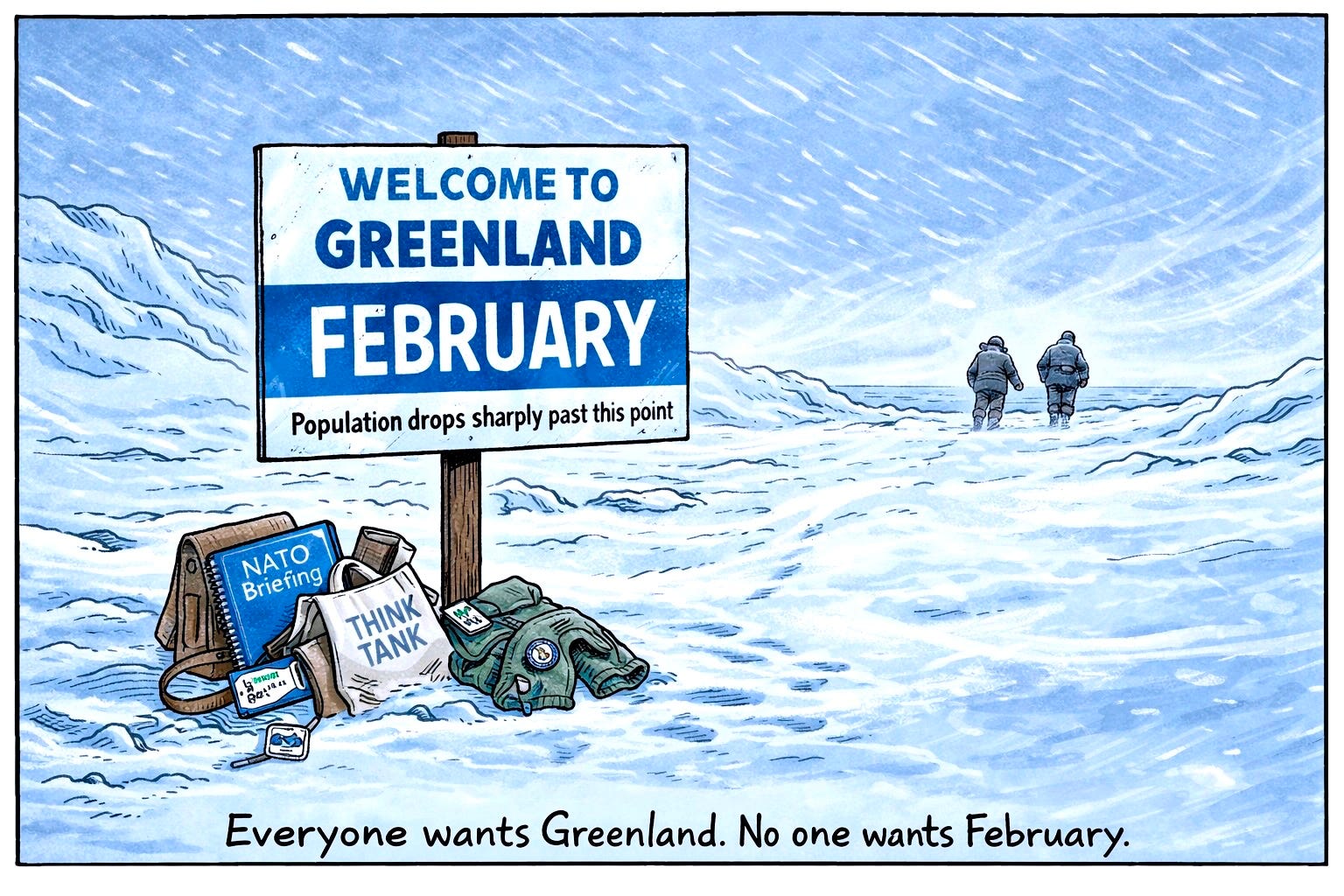
Greenland has outlasted empires by doing absolutely nothing.
Empires arrive with maps, doctrines, and confidence.
Greenland arrives with February.
February is where theories go to die. It is not symbolic cold. It is operational cold—the kind that converts enthusiasm into logistics, regret, and return flights.
February does not debate. It does not negotiate. It does not read white papers.
(It doesn’t need to. February in Greenland is already white enough.)
This is why Greenland is interesting to the world—from a distance.
Distance allows people to speak fluently about Greenland without encountering it. It turns a harsh, sparsely populated place into an abstract asset—something to be discussed, modeled, and optimized. It allows people who have never set foot there to speak with confidence about what must be done.
Everyone wants Greenland—strategically. No one wants February—personally.
The February Filter
February is Greenland’s sorting mechanism.
Delegations arrive bundled in borrowed parkas, speaking loudly about cooperation, frameworks, and long-term engagement. They leave quietly, having learned that the land does not care what they say.
February does not reward preparation. It punishes the absence of it.
Why Power Keeps Misreading the Place
Power assumes scale. Greenland enforces proportion.
There are no crowds to impress, no capitals to overwhelm, no momentum to ride. There is only weather, distance, and time—lots of time.
This is how Greenland has survived attention.
While empires rose and fell, Greenland stayed cold. While ideologies bloomed and collapsed, Greenland remained inconvenient. While strategies were announced, revised, and abandoned, February kept returning on schedule.
Greenland did not resist history. Its geography declined to participate.
Permanence does not issue press releases. It does not escalate. It simply continues, unchanged, while others exhaust themselves explaining why action is urgent.
February ensures that anyone serious about Greenland has to slow down.
Everyone Wants to Be Arctic Now
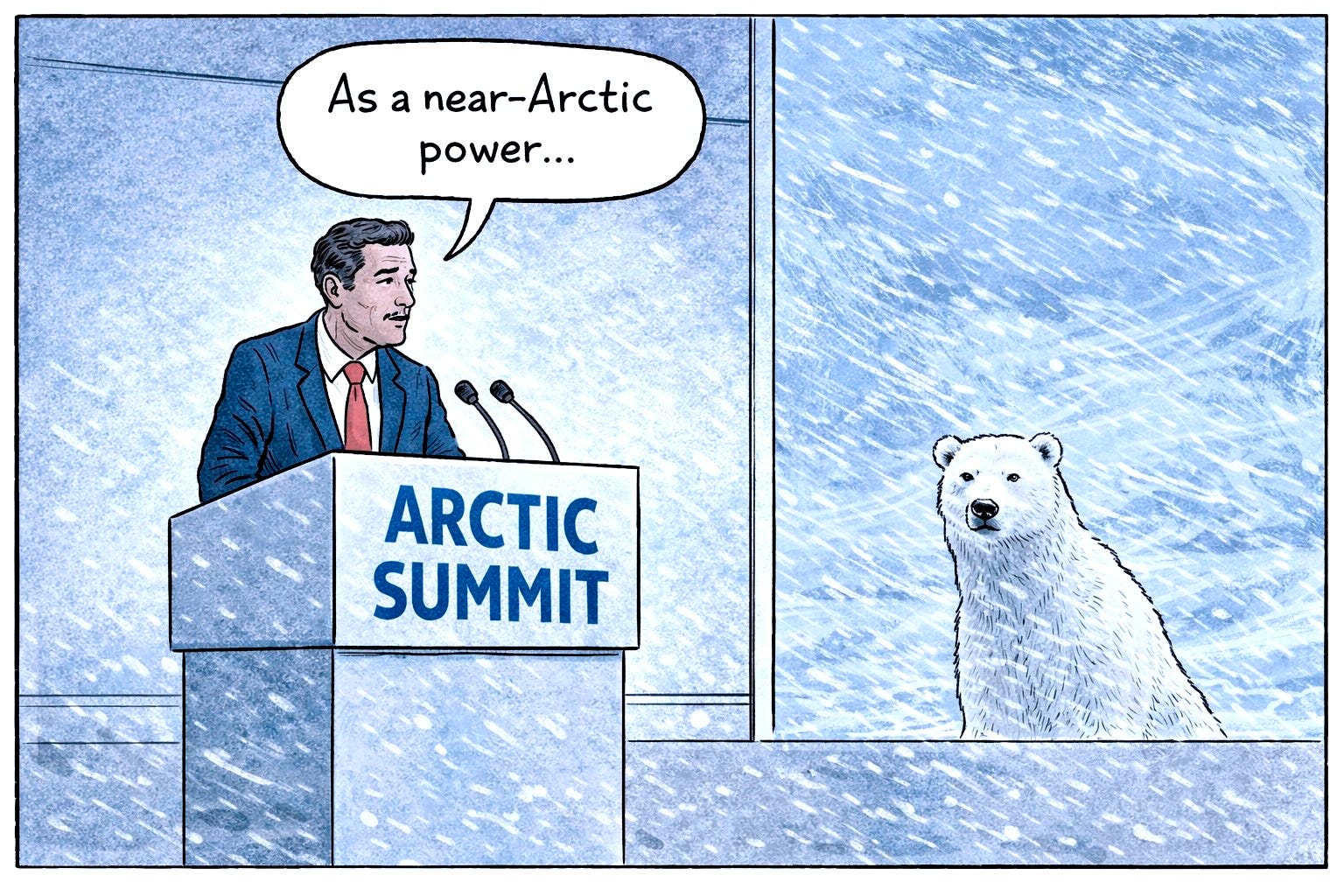
Which brings us to the rise of the “Near-Arctic Power.”
A Near-Arctic Power is a country that is not Arctic, has never been Arctic, but would like it noted for the record that it has strong feelings about the Arctic.
This is how you get nations thousands of miles south of the polar circle issuing Arctic strategies with straight faces.
The term is not recognized by maps. It is recognized by conferences.
China
China describes itself as a “near-Arctic state.” This is technically true if one defines near very generously and ignores oceans.
China’s interest is methodical: shipping routes as ice recedes, minerals not yet mined, and research stations that look scientific and function strategically.
None of this is secret. China published an Arctic policy paper explaining exactly what it intends to do, which is always reassuring—until people read it.
China does not rush. It studies, invests, and waits.
This unsettles countries that prefer enthusiasm to patience.
Russia
Russia does not call itself near-Arctic. It is Arctic.
Much of its northern border lies above the Arctic Circle, and Moscow treats the region accordingly—as strategic frontage for bases, ports, and patrols.
While others issue white papers, Russia clears ice.
This is why European Arctic discussions grow tense when Russia enters the room. Russia does not speak in hypotheticals.
Europe
Europe, geographically closer than China, approaches the Arctic in the careful language of norms, sustainability, and consensus. It understands the stakes but prefers that confrontation be politely postponed.
The Greenland Effect
Greenland sits at the center of all this interest and reacts the same way it always has: patiently.
China explored investment. Denmark quietly intervened. The United States began paying closer attention. Everyone insisted this was routine.
Greenland noticed the attention and continued being cold.
What unsettles outsiders is not what Greenland does—but what it refuses to do. It does not hurry. It does not audition. It does not confuse interest with obligation.
Near-Arctic Powers share a common trait: they want the benefits of Arctic access without the cost of Arctic permanence.
They want shipping lanes, minerals, and strategic leverage—without February.
“Near-Arctic Power” exists because no one wants to say the quieter truth:
Geography still matters, and it is not impressed by ambition.
The Inevitable Collision
As ice recedes, interest increases. As interest increases, competition follows.
Everyone insists they are there for science. Everyone also wants leverage.
Greenland listens. February waits.
The Takeaway
Greenland understands something outsiders repeatedly forget: attention is temporary.
It has watched waves of interest come and go for centuries. Each arrives convinced it is different. Each leaves surprised by how little changed.
Plans demand acceleration. Greenland demands endurance.
February has been winning that argument for a very long time.
And Greenland remains Greenland.
Always a worthwhile read.
Since I refuse to endure literary
Hypothermia may I make a simple
Request?
Please give your opinion, not as
An Arctic meteorologist, but as
a view of Trump's contretemps?
Is Greenland worth it?
There is more to Greenland than meets the eye or the cold.