
HAPPENSTANCE
A Phantom Book
Publishing is full of liminal oddities: announced books that never appear, canceled titles that linger in catalogues, ghost editions no one has seen, rights tied up in legal amber.
Every author has a few oddball publishing stories. Livingston Biddle’s sad story was the best I ever heard—and maybe one day I’ll write it up.
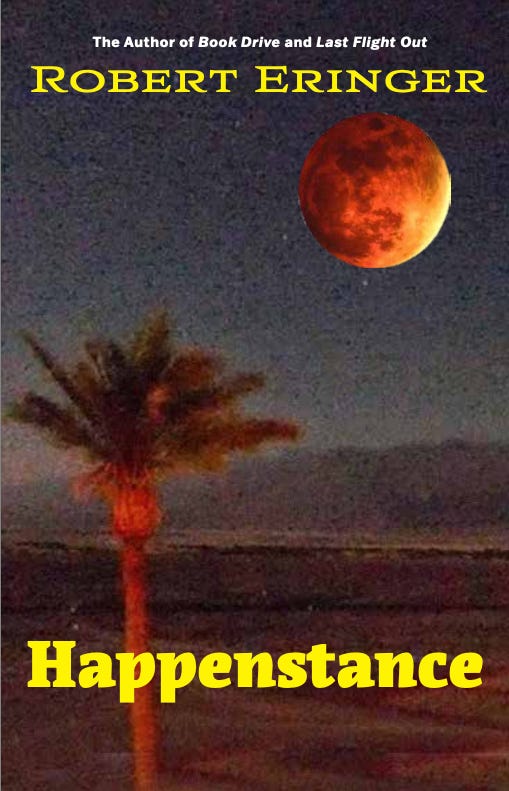
But this post is about Happenstance, a book of my own that technically exists.
Except it doesn’t. Or shouldn’t.
Yet somehow, here it is on Amazon…
A book that was never published.
Not delayed. Not remaindered. Not quietly pulped.
Never published.
And yet—like a literary ectoplasm—it appears online complete with ISBN, cover image, bibliographic details, and the general air of something one might actually order.
So what happened to this phantom novel?
A few years ago, Happenstance (a fitting title, given the situation) was in the pipeline at a small independent outfit called Bartleby Press—a one-man-band with a support team run by Jeremy Kay.
Jeremy was bright and enthusiastic, if prone to procrastination.
But this time, Jeremy procrastinated just a wee bit too long.
Just as my novel was moving toward production, he got tapped—much too young—by the grim reaper.
And with him, so died Happenstance.
No press run. No launch. No bookstore signings.
No nothing.
Except a phantom listing on Amazon.
I have no idea whether clicking “Buy Now” results in an actual shipment, a billing without product, or a mild disturbance in the space-time continuum.
Was some metadata uploaded before Jeremy’s untimely exit and then left to drift forever through the digital void?
Was a single proof copy printed somewhere and mistaken for an actual release?
Did a publishing daemon decide unfinished books deserve their own shelf?
Did the powers-that-be intervene due to the novel’s content?
Written a decade ago, Happenstance was oddly ahead of its time—touching on the potential dangers of artificial intelligence, and AI’s connection to UFOs.
One thing is for sure: Like Schrödinger’s Cat, this novel now exists in a suspended state between life and death—except with fewer whiskers and an ISBN.
A couple of years ago I serialized Happenstance for paid subscribers.
Perhaps it’s time to exhume it for everyone.
And if I do—and this Substack platform mysteriously vanishes shortly thereafter—I shall take that as conformation I was on to something.
In advance of such an eventuality, here is the original Bartleby marketing copy for the phantom Happenstance.
Once a popular print columnist, Meechy Blake has settled into an uneasy retirement. His dream about writing a major book exposing the dangers of artificial intelligence have faded, along with his dwindling bank account.
He reluctantly accepts a reporting assignment from a webzine, if only to pay an unexpected debt.
The assignment? A seemingly fluffy travel piece about an obscure canyon in southern California called Devil’s Gate.
Driving down the coast, Blake takes the opportunity to reestablish contact with a secretive source from the old days—a retired scientist he nicknamed Dr. Boom-Boom, who once resided at the very hub of the U.S. government’s national security establishment.
When Blake tells Boom-Boom where he’s going, the scientist tries to caution him about engaging Devil’s Gate, an eerie site with an occult connection.
Blake laughs off the warning and continues onward, fully embracing his assignment.
That’s when things begin to go seriously wrong and, after a few strange encounters, Blake realizes he has become a target.
But why—and by whom?
Carefully covering his tracks, Blake sets off on a journey to answer these vexing questions, leading him to the hottest place on earth.
Happenstance takes the reader into some very shadowy territory. And as Blake’s questing for the truth evolves, certain secrets come to light that may have the reader asking, Is this really just a fantasy—or is the author revealing some hidden truth?
That nagging question is made all the more tantalizing by author Robert Eringer’s enigmatic background in the world of intelligence and espionage—and his journalistic reveals of that veiled community.