

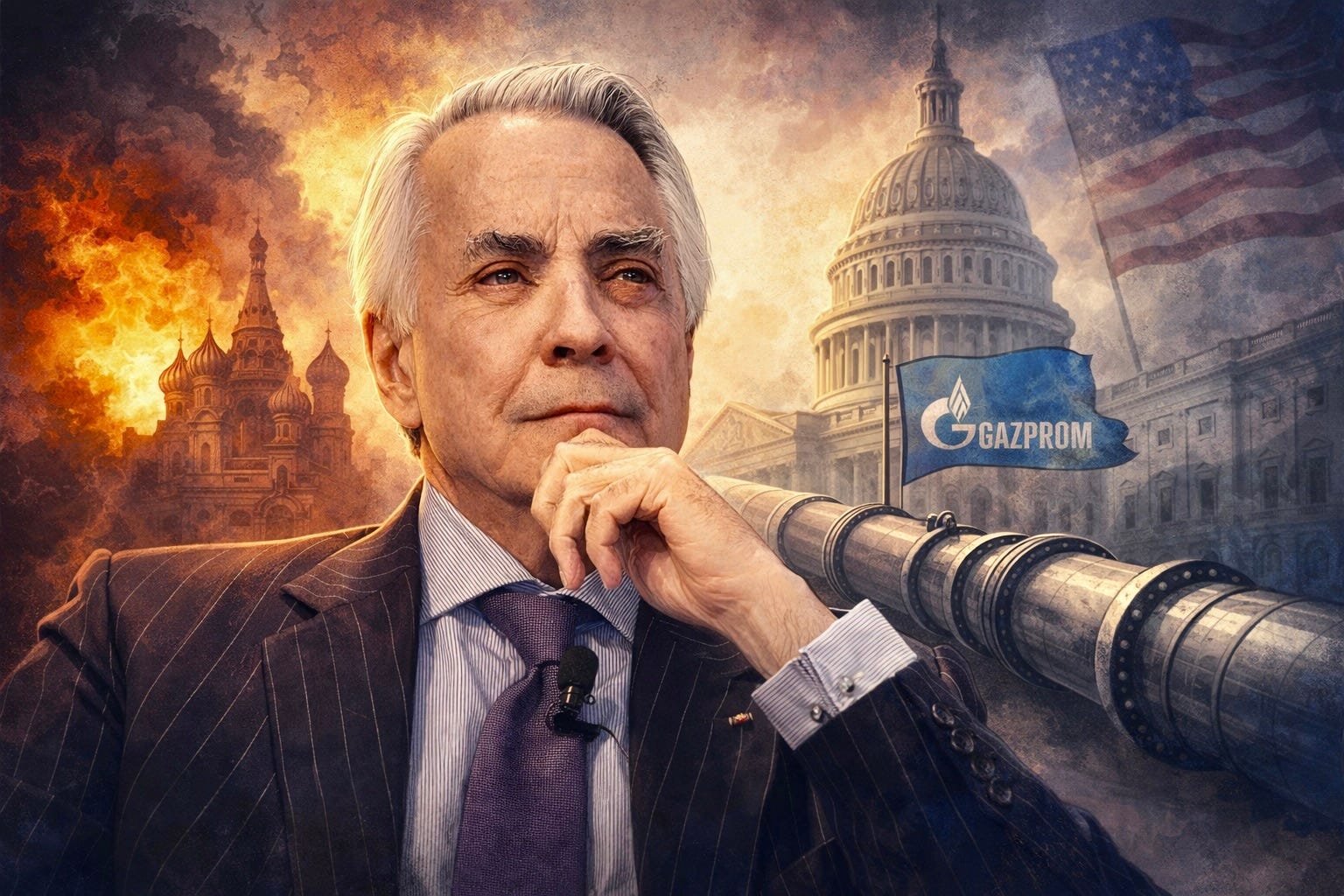
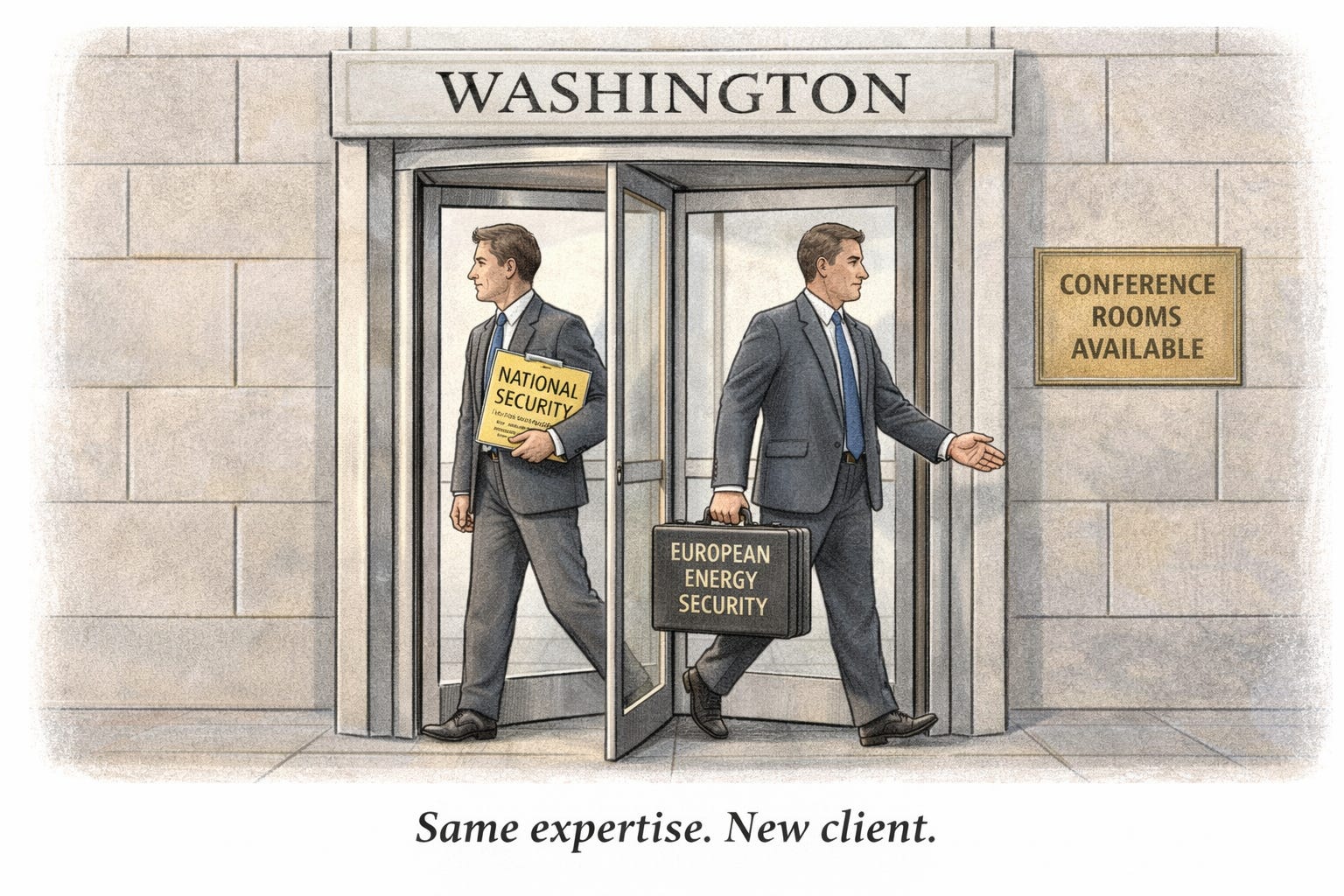
Washington has a favorite magic trick: it takes a man who once warned you about the Soviets, runs him through the revolving door, and he comes back out carrying a briefcase full of “European energy security” that favors his former sworn enemy.
Enter Richard Burt—ex-government heavyweight, Reagan-era hardliner and diplomatic résumé. The type who once spoke of the Kremlin as a permanent adversary.
Burt was not some marginal Cold War relic. He was Assistant Secretary of State for European and Canadian Affairs, U.S. Ambassador to West Germany, and a central figure in arms-control negotiations with the Soviet Union. His credentials were built on opposition—ideological and strategic.
After leaving government, Burt joined McLarty Associates, founded in 1998 by Thomas F. “Mack” McLarty III shortly after his tenure as President Clinton’s first White House Chief of Staff.
From the outset, the firm was designed not as a conventional lobbying shop but as a strategic advisory operation built around access, relationships, and fluency in Washington’s power structures. McLarty did not invent the revolving door; it professionalized it, systematizing the conversion of government service into private-sector leverage while remaining fully embedded within Washington’s norms and rules.
Burt became a senior partner at McLarty Associates in 2008. In that position, he lobbied on behalf of Russian gas to expand flow through Europe in a manner that conveniently bypassed Ukraine and greatly benefited Vladimir Putin’s regime.
This is not interpretation. This not inference. The paperwork speaks for itself.
Receipt #1: New European Pipeline AG—Gazprom
A 2016 Lobbying Disclosure Act filing by McLarty Inbound for New European Pipeline AG, the corporate vehicle associated with Nord Stream 2.
Two years earlier, in 2014, Russia invaded and annexed Crimea—the first forcible redrawing of European borders since World War II. The response from the United States and its allies was swift by diplomatic standards: coordinated sanctions targeting Russian banks, energy firms, and individuals tied to the Kremlin. The intent was explicit—to impose economic cost, constrain Russian leverage, and signal that territorial conquest carried consequences.
Nord Stream 2 emerged against that backdrop, not before it. The pipeline was conceived, financed, and advanced after Crimea, at precisely the moment when Russia was seeking ways to blunt sanctions pressure, preserve energy dominance in Europe, and bypass Ukraine altogether.
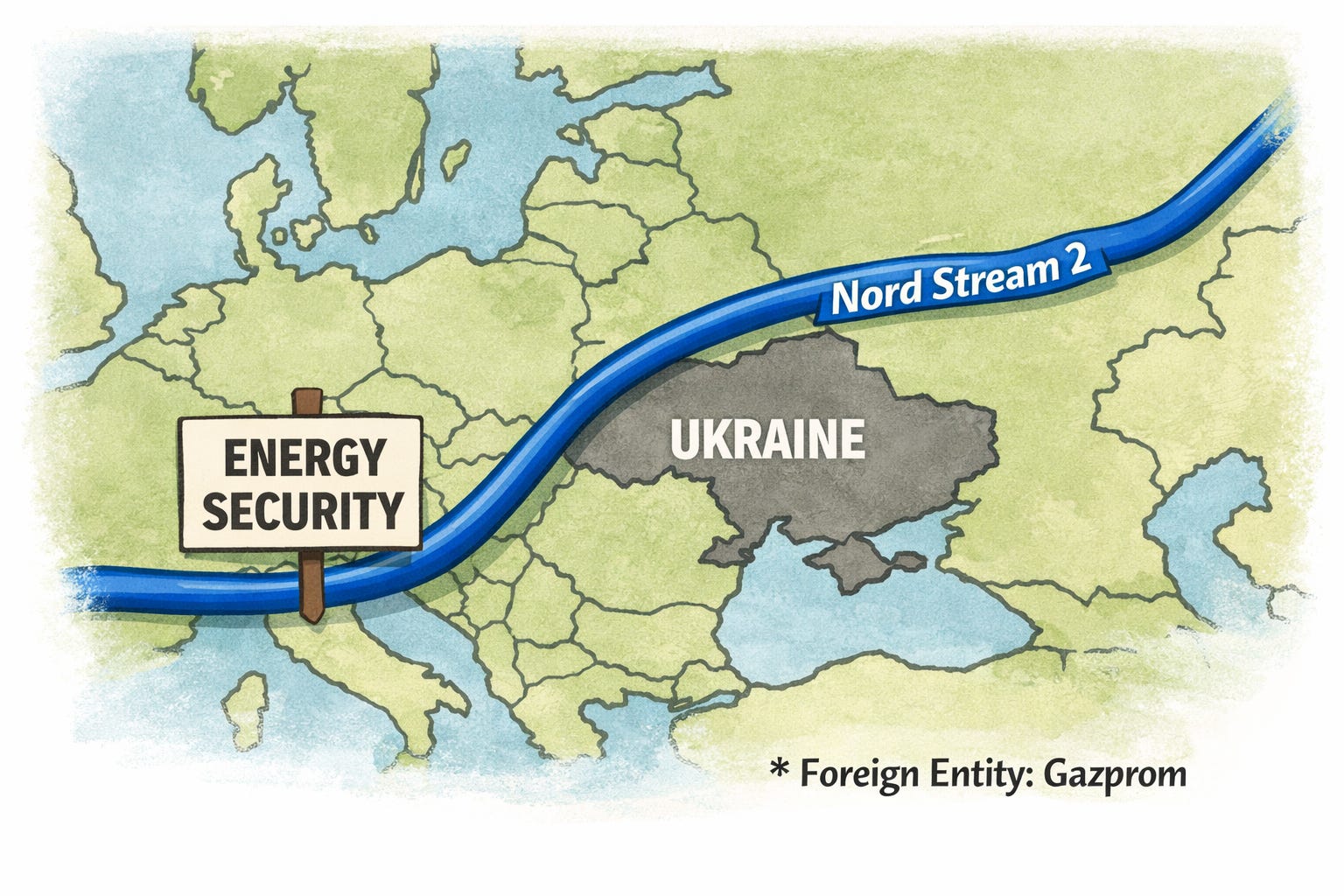
On the form’s foreign entity interest page, the owner is listed plainly: Gazprom—first as a majority stakeholder alongside European partners, later as the sole owner.
“Foreign entity” is the Lobbying Disclosure Act’s polite bureaucratic phrasing. In ordinary English it means: this is not a domestic interest.
It means: you are being paid to advance the concerns of a foreign power.
In this case, the “foreign entity” was Russia’s state-owned energy giant, an instrument of national strategy as much as commerce.
Then comes the language Insider Washington uses to anesthetize itself.
The issue description reads: “Monitoring and supplementing Washington discussion of EU energy security.”
Not lobbying, you understand—just lubricating a conversation.
But the conversation was not abstract.
A related filing spells out the capital structure behind that “energy security”: Gazprom at the center, flanked by a neat ring of European energy majors, including OMV, Austria’s largest energy company and longterm Gazprom collaborator.
The project’s strategic effect was obvious to anyone not pretending otherwise: expand Russian gas flows into Europe while bypassing Ukraine’s transit system, weakening Kyiv economically and politically.
This was not a technical dispute. It was a geopolitical redesign.
The Politico Overlap: Two Tracks, One Operator
The missing link exposed.
In 2016, Politico reported that Burt occupied a two-track posture: he publicly associated himself with the Trump Campaign’s foreign-policy discussions—including claims of helping shape an early Trump foreign-policy speech—while his firm was simultaneously being paid to lobby on behalf of a pipeline project aligned with Russian strategic interests.
The Trump campaign downplayed the relationship (probably because there was no relationship). Burt then downplayed his role.
Burt used the same language Washington always uses in such moments: not advising, just offering thoughts; not influencing, just participating; not directing, just helping.
What went largely unexamined at the time was the obvious alternative explanation: that Burt may have been ingratiating himself with the Trump campaign not as a free-floating policy intellectual, but as a credentialed intermediary whose private-sector client had a direct stake in the outcome.
There was no formal tasking, written instructions, or clandestine coordination. In Washington, influence often operates more subtly—through proximity, availability, and the strategic offering of “expertise” at precisely the moment a formidable campaign is forming its worldview.
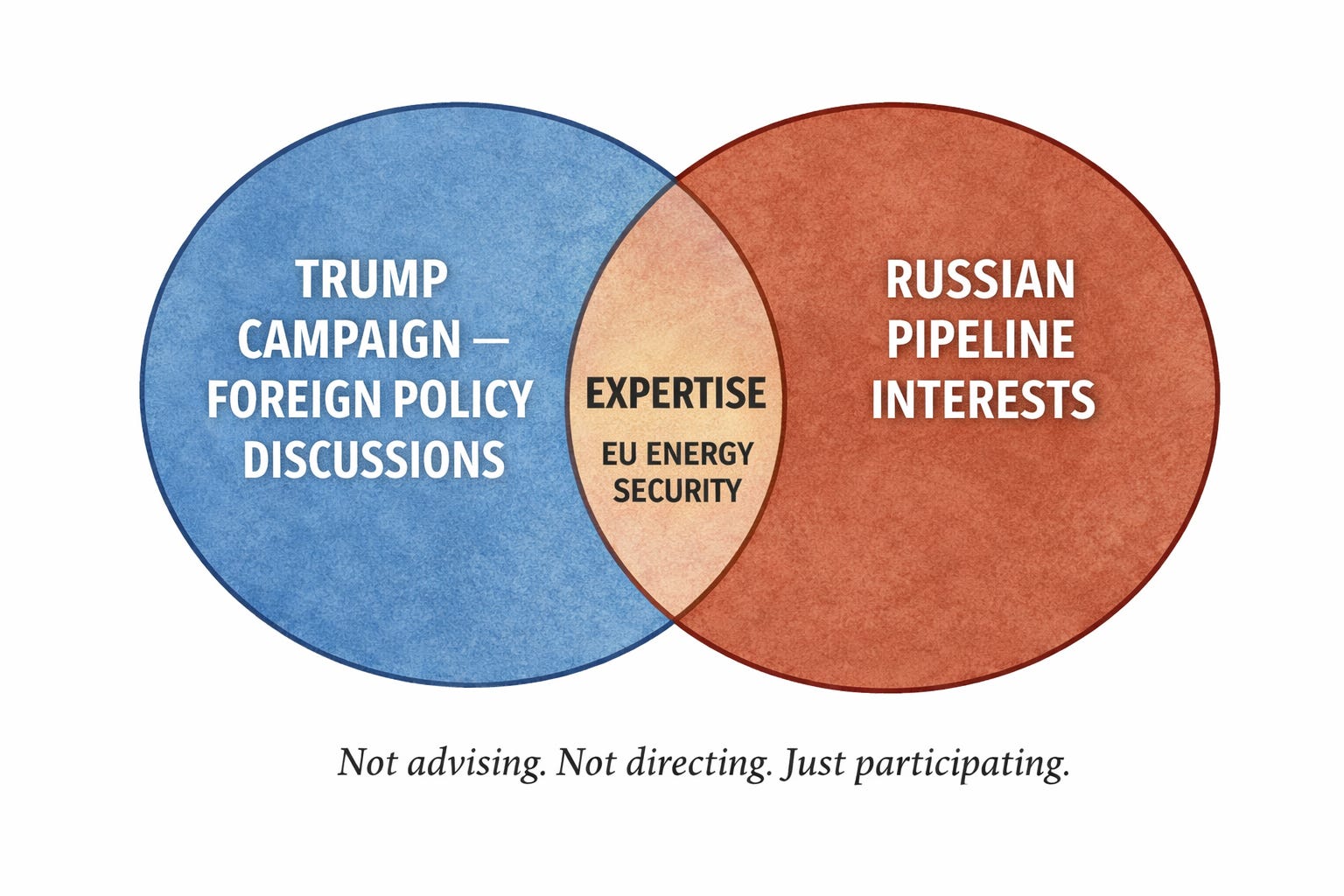
From that perspective, Burt’s presence around Trump-world discussions can reasonably be read as a form of soft infiltration: not espionage, but insertion—embedding a trusted establishment figure into an emerging political operation, carrying with him a policy frame (“European energy security”) that conveniently aligned with the interests of his client (Gazprom/Russia).
This is how influence actually happens in Washington—not through covert meetings in Prague, but through respectable intermediaries who can plausibly deny formal roles while quietly bonding policy formation with private interest.
No law needs to be broken. No envelope needs to change hands.
Receipt #2: OMV and the Sanctions Industry
The second receipt removes any lingering doubt about intent.
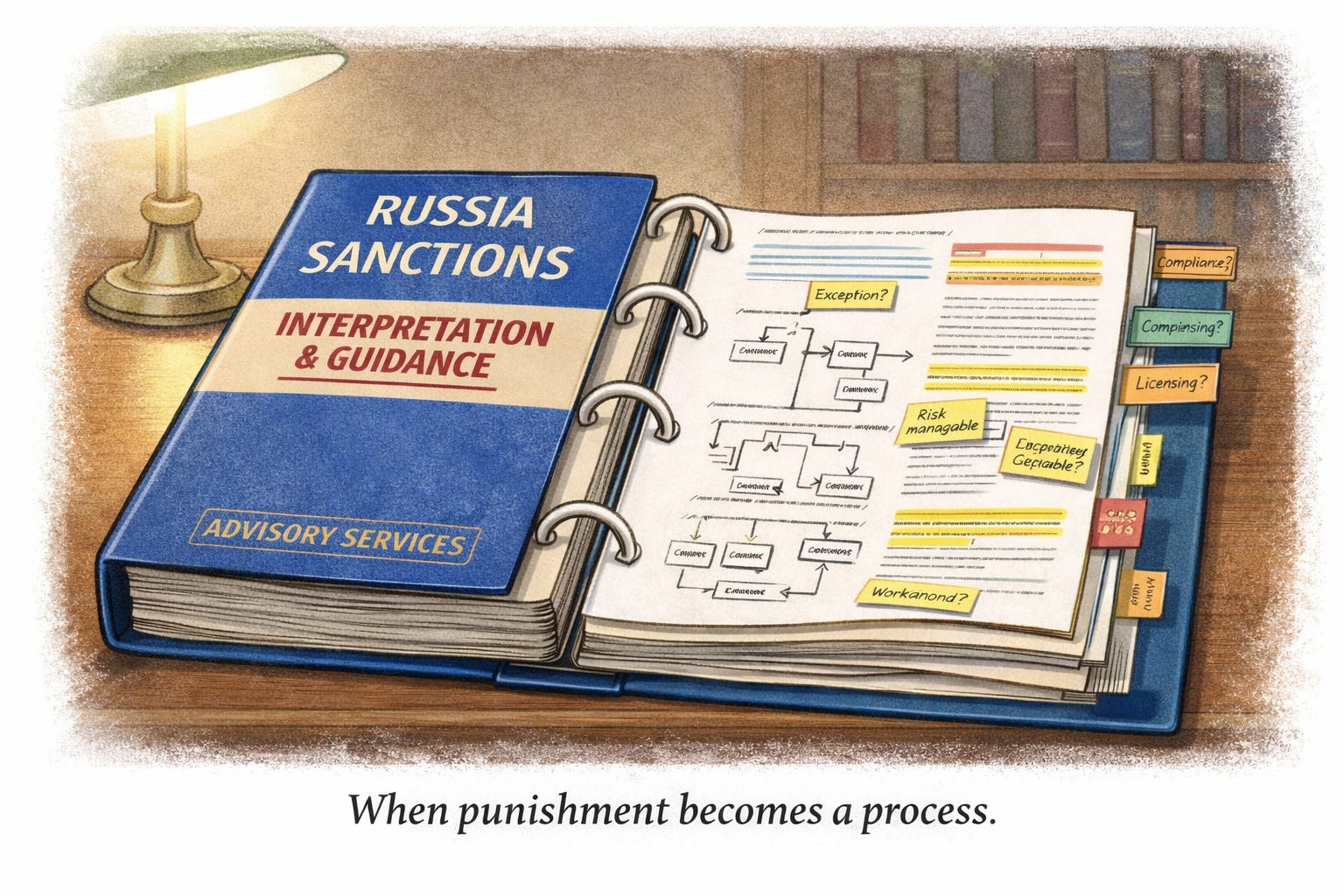
McLarty Inbound filings for OMV include language stating that the firm would advise on “Russia sanctions issues.”
Read that again.
A firm employing a former U.S. ambassador and Cold War hardliner is hired by a major European energy company to advise on sanctions against Russia—while Russian pipeline interests remain the focus center of the entire project.
This is not an accident of phrasing. It is a mission statement.
Sanctions are not merely punishments; in Washington they are also a market. Once imposed, they generate a cottage industry of navigators, interpreters, and “advisers.” The same ecosystem that helps projects advance before sanctions often reappears to help clients survive after sanctions arrive.
Receipt #3: February 2022 and the Rediscovery of Virtue
Then February 2022 arrives. Russia invades Ukraine. The West sanctions Russia.
Suddenly, K Street discovers a previously unknown organ called “values.”
Associated Press reported that McLarty and other firms were cutting ties with Russian-linked clients. Burt himself described the withdrawal as “the honorable thing to do.”
Translation: the music stopped, and everyone lunged for the nearest chair.
But honor in Washington is often indistinguishable from compliance. Sanctions hardened. Reputational risk spiked.
What changed was not the underlying conduct. It was the optics.
Why This Escaped Crossfire Hurricane and Mueller
This is the part that matters most—and the part that explains everything.
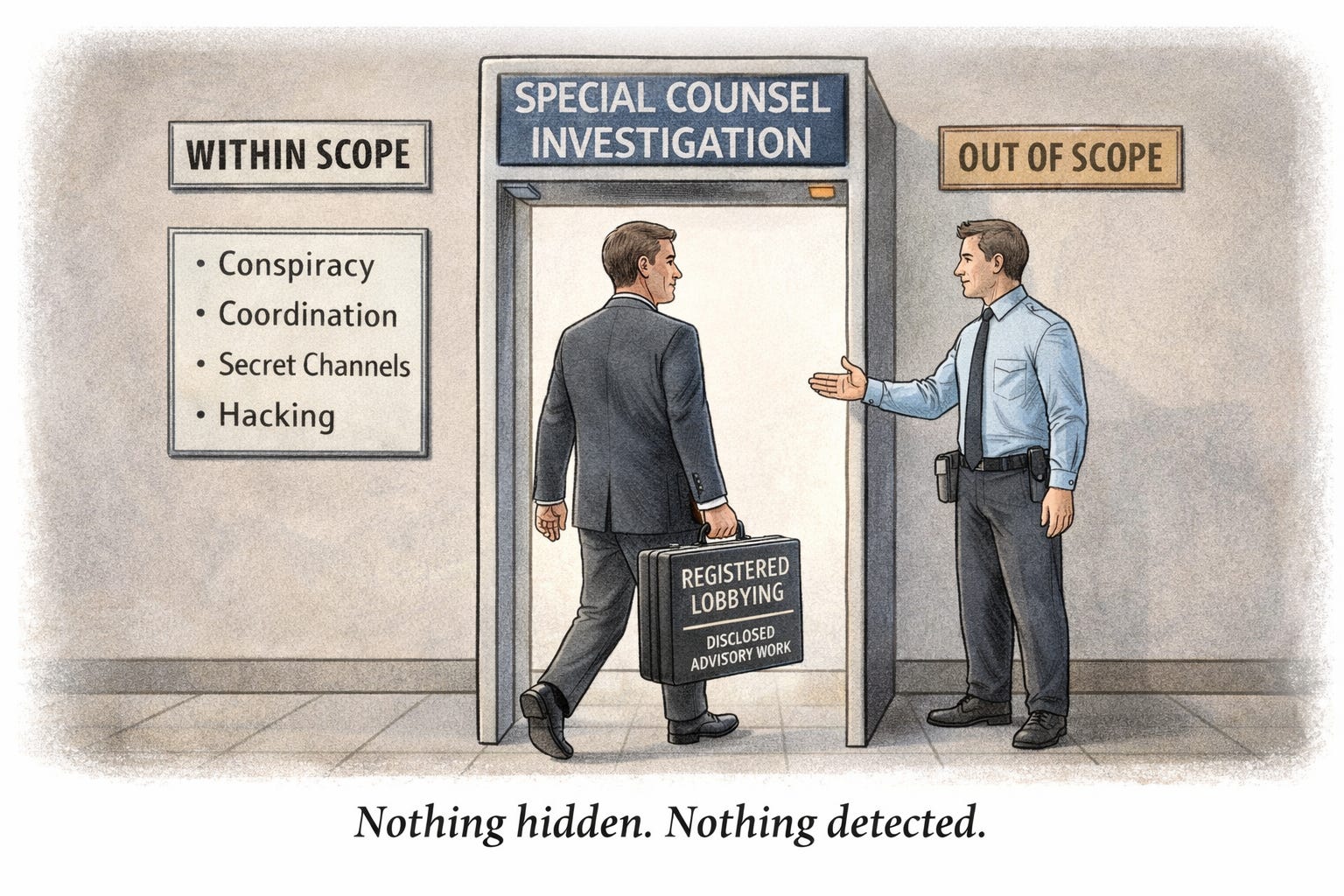
Neither Crossfire Hurricane nor the Mueller Report was designed to examine this class of activity.
Those investigations were scoped for conspiracy, coordination, hacking, clandestine contacts, and election interference. They looked for spies, moles, and secret channels. (And came up empty.)
What they were not built to interrogate was registered influence—the kind that hires former officials, files on time, and speaks fluent bureaucratese. Lobbying performed by establishment figures through blue-chip firms does not trip counterintelligence alarms. It is considered business as usual.
This is what people loosely call the “Deep State,” though the more accurate term is Insider Washington: the interlocking world of former officials, advisory firms, think tanks, and compliance professionals who persist across administrations and monetize influence.
Mueller didn’t “miss” this. It was out of scope by design.
To interrogate it would have meant interrogating Insider Washington itself.
So what are we looking at?
The epitome of the revolving-door syndrome: a man who was trained to identify Kremlin leverage now spending the back-half of his career helping that leverage find a conference room, a talking point, and a polite euphemism for his former enemy.
If you want a succinct summary: Russia did not need to penetrate Washington. Washington made itself available.
The infiltration mechanism is not a spy with a microfilm tube. It is a retainer agreement, a sanitized description, the ability to call something “European energy security” as a euphemism for European dependence on Russian oil and gas.
The real scandal is not that this happened. The real scandal is that it is considered normal.
Nothing here required secrecy or subterfuge.
It required only a system that treats influence as a commodity, expertise as a passport, and foreign interests as clients so long as they pay well and the paperwork is in order.
What should raised alarms passes as routine.
What this helps explain is the policy atmosphere in which Donald Trump’s unusually accommodating posture toward Vladimir Putin took shape.
Trump did not arrive in Washington with a coherent Russia doctrine; he arrived with instincts, grievances, and a skepticism of sanctions and alliances.
Figures like Burt, operating in the space between campaign and Insider Washington, supplied something Trump lacked: a ready-made framework that cast cooperation with Russia not as concession, but as pragmatism—“realism” and “stability.”
In that sense, Trump’s pro-Putin rhetoric did not emerge in isolation. It was reinforced by an ecosystem that had already learned how to translate Russian strategic interests into respectable policy language—and sell it as expertise.
It is a story about how power circulates in Washington, how influence is sold, and how systems designed for transparency can become tools of concealment.
In other words, hidden in plain sight—and accepted.
TIMELINE OF THE PIPELINE STORY
2014—Crimea
Russia invades and annexes Crimea, marking the first forcible redrawing of European borders since World War II.
The move fundamentally alters the European security and energy landscape.
Ukraine’s role as a gas transit state becomes strategically vulnerable.
2014–2015—Sanctions
The United States and European allies impose coordinated sanctions on Russian banks, energy firms, and Kremlin-linked individuals.
Sanctions explicitly target Russia’s ability to leverage energy dominance for geopolitical influence.
Energy infrastructure becomes a sanctions-sensitive domain.
2015–2016—Nord Stream 2 Lobbying
Nord Stream 2 is conceived and advanced after Crimea, not before.
Gazprom emerges as the central foreign interest behind the project.
McLarty Inbound files Lobbying Disclosure Act reports on behalf of New European Pipeline AG, describing work as: “Monitoring and supplementing Washington discussion of EU energy security.”
The project’s strategic effect is clear: expand Russian gas flows into Europe while bypassing Ukraine.
2016—Trump Campaign Overlap
Richard Burt, a former Reagan-era official and senior McLarty figure, appears in proximity to Trump-world foreign-policy discussions.
Politico reports on Burt’s dual posture:
Association with Trump campaign foreign-policy conversations.
Simultaneous paid lobbying on behalf of a Russian-aligned pipeline project.
No formal advisory role is acknowledged; influence operates through access, proximity, and “expertise.”
2019–2021—Sanctions Navigation
McLarty Inbound filings for OMV include explicit language about advising on “Russia sanctions issues.”
Sanctions compliance and navigation emerge as a professional service.
Russian energy interests remain the gravitational center of the policy environment.
February 2022—Full-Scale Invasion
Russia launches a full-scale invasion of Ukraine.
Sanctions intensify dramatically; reputational and legal risk spikes.
Russian-linked energy projects become politically radioactive.
February–March 2022—Withdrawal
McLarty and other firms terminate Nord Stream–adjacent engagements.
Termination filings appear in the LDA database.
Burt characterizes the withdrawal as “the honorable thing to do.”
There is no evidence that Burt or McLarty continue to represent Russian state interests after March 2022.
What remains unchanged is a system that still rewards the same expertise, relationships, and access under different descriptions.
The disappearance of “Russia” from public filings does not indicate the disappearance of the underlying market; it indicates only that it has become less visible.