
MAPPING THE CONSTELLATION
The FBI's Charles McGonigal, Mark Rossini, and the Curious Case of Missing Questions

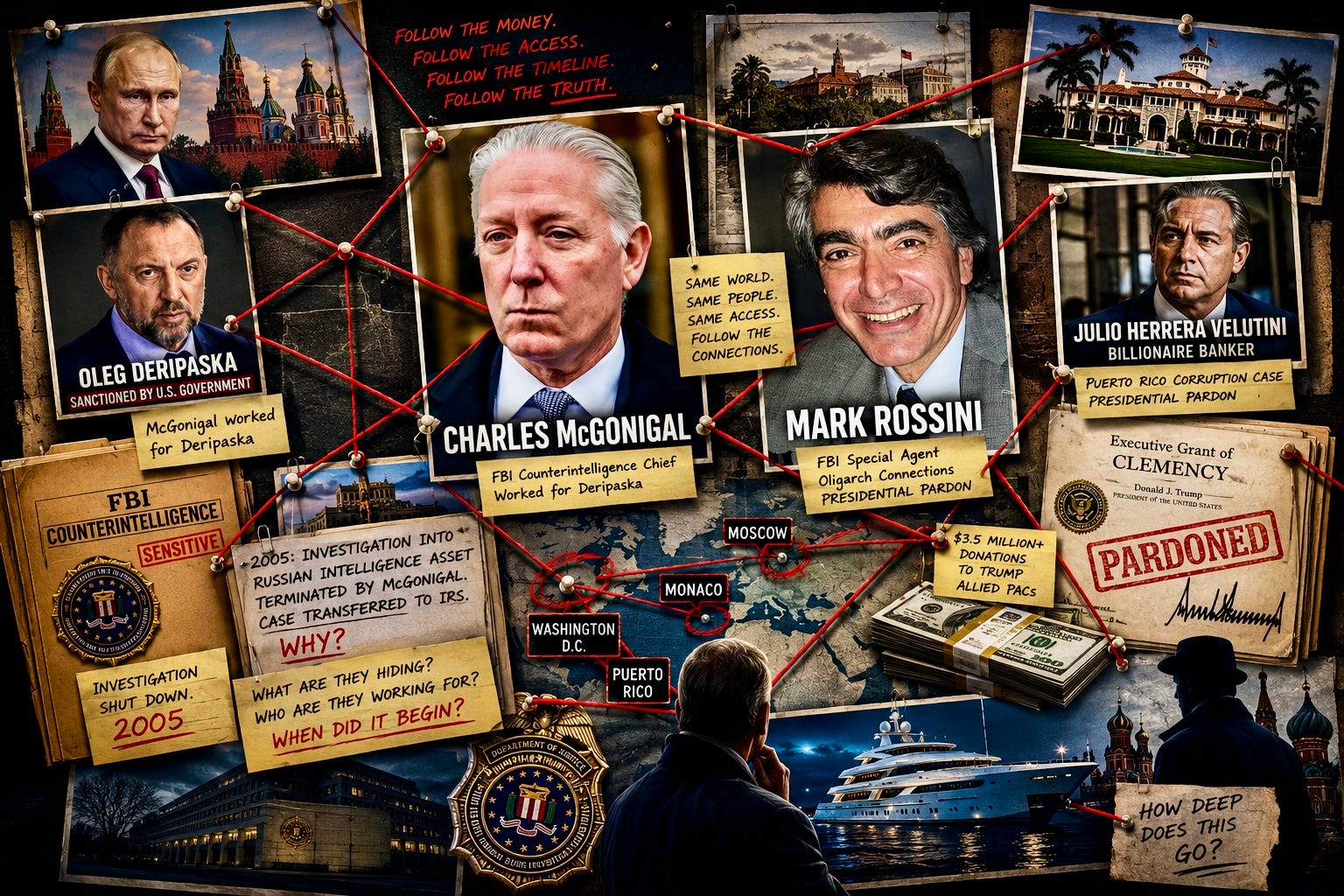
One of the occupational hazards of spending a few decades in intelligence and espionage is that eventually you stop accepting official explanations at face value.
Which brings us to former FBI counterintelligence supervisor Charles McGonigal and former FBI special agent Mark Rossini.
The official story is straightforward:
McGonigal was convicted after secretly working for sanctioned Russian oligarch Oleg Deripaska while concealing relationships and payments that should have ended his career.
Rossini, meanwhile, became entangled in a Puerto Rico corruption case involving billionaire banker Julio Herrera Velutini before receiving a presidential pardon.
Simple enough.
Except intelligence stories are rarely simple.
Rossini and McGonigal were considerably closer than casual professional acquaintances.
According to Albanian corporate records, they each owned a 25 percent stake in a company called Lawoffice & Investigation.
Their third partner was Agron Neza, a former Albanian intelligence officer.
Neza would later become a central figure in McGonigal’s downfall.
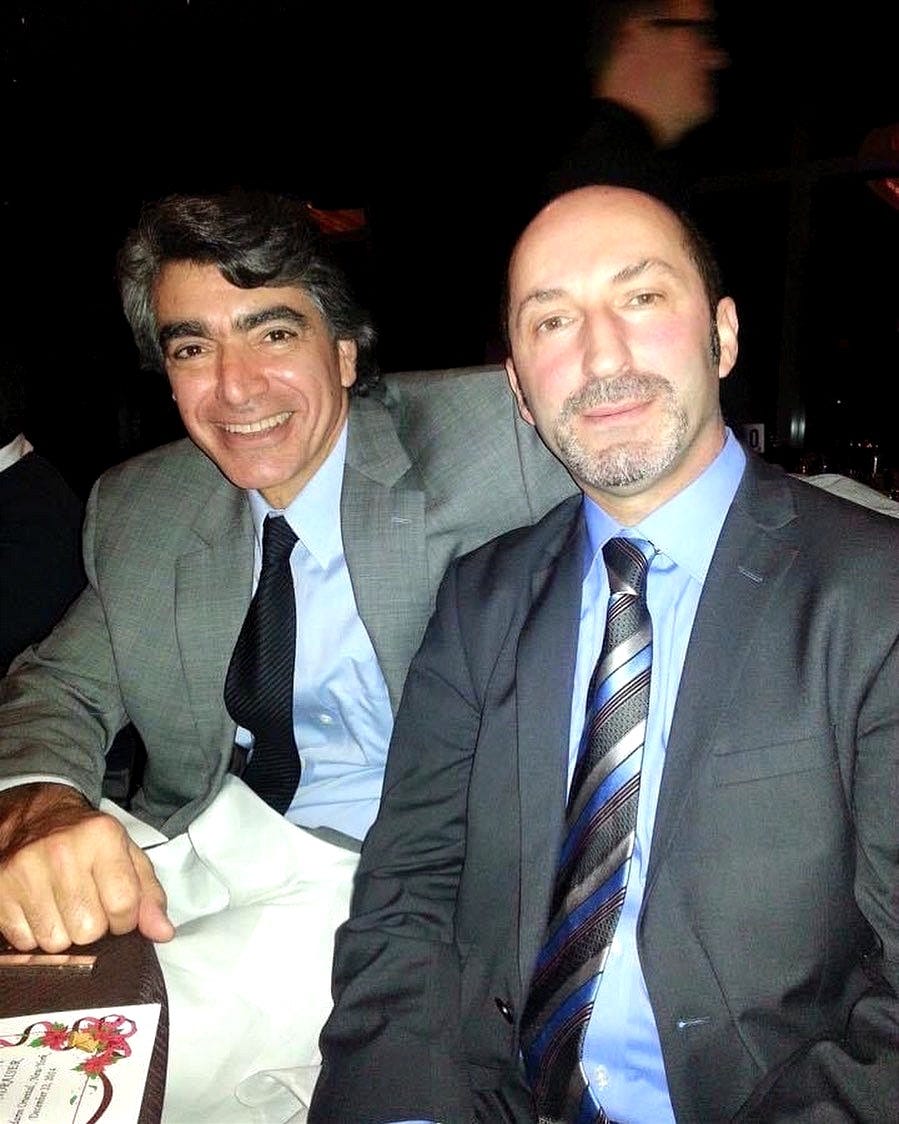
According to federal prosecutors, Neza provided McGonigal with approximately $225,000 in cash while McGonigal was serving as Special Agent in Charge of FBI Counterintelligence in New York. Some payments allegedly occurred at Neza’s New Jersey residence. Others allegedly took place inside a parked vehicle.
McGonigal ultimately pleaded guilty to concealing those payments and separately pleaded guilty in a second case involving sanctioned Russian oligarch Oleg Deripaska.
So: Rossini and McGonigal are not unrelated names appearing in adjacent headlines.
They are part of the same story. Both worked with Agron Neza.
And that story is not merely about corruption.
It is about a network of former intelligence and law enforcement officials operating in a world where access, influence, relationships, and foreign money frequently intersect in the increasingly lucrative post-government world where former intelligence officials discover that old contacts, old access, and old credibility can be monetized more effectively than pensions.
According to recent reporting, Rossini also performed services for entities connected to Russian oligarchs Oleg Deripaska and Dmitry Rybolovlev—both men long associated with Vladimir Putin’s orbit.
When prosecutors later attempted to question Rossini under oath regarding the nature of that work, he invoked the Fifth Amendment and declined to answer. A federal judge agreed that his concerns about potential criminal exposure were reasonable.
The same reporting argues that a trial involving Rossini and his Puerto Rico co-defendants could have exposed uncomfortable details regarding what former U.S. intelligence and law-enforcement officials were actually doing on behalf of wealthy foreign clients.
Then came the Trump pardon.
Huh?
Adding another layer of intrigue, the daughter of Rossini’s co-defendant, banker Julio Herrera Velutini, donated $2.5 million to a Trump-aligned super PAC and later contributed another $1 million. Six months after the first donation, clemency arrived for Velutini, former Puerto Rico Governor Wanda Vázquez, and Rossini, sparing the three defendants from further legal jeopardy
It permanently closed a door through which a much larger story might have emerged.
What fascinates me is not the pardon itself and lack of news about it.
What fascinates me is the sudden disappearance of curiosity.
A former chief of FBI Counterintelligence is caught secretly working for a Kremlin-connected oligarch.
A former FBI agent is simultaneously operating inside a web involving international bankers, political influence, and wealthy foreign interests—with the same Russian oligarch and Albanian intelligence official.
Foreign money. Political donations.
Then everyone collectively decides these are isolated events.
Cases closed. Move along. Nothing to see here.
Really?
Recent reporting surrounding Rossini’s pardon argues that legal proceedings might have exposed uncomfortable details regarding other former FBI officials operating on behalf of oligarch networks.
Intelligence professionals hear the words Russian oligarch, counterintelligence chief, and consulting contract somewhat differently than television commentators.
To most people, it sounds like corruption.
To intelligence officers, it sounds like recruitment. It sounds like influence. Like access. And leverage.
All four.
My own concerns regarding McGonigal predate the Rossini pardon.
By many years.
In fact, they date back to 2005.
At the time, while serving as intelligence adviser to Prince Albert II of Monaco, I provided information to FBI Counterintelligence officials regarding an individual we believed had been recruited by Soviet intelligence during the Cold War, and in retirement was still spying for the Russians. Specifically, spying on the President’s Foreign Intelligence Advisory Board.
Our target had accumulated extraordinary wealth.
There were no explanations for his wealth.
The FBI opened an official investigation.
McGonigal was assigned its supervisor at headquarters.
Eventually, something strange happened.
Just as the investigation appeared to be gathering momentum (two years after it began), McGonigal informed me that the counterintelligence aspect would be terminated and the matter handed off to the IRS as a financial case.
The explanation made little sense then. It makes even less sense now. Unless, in hindsight, due to recent events, it makes a lot of sense.
Counterintelligence investigations do not normally vanish because financial crimes may also exist. And the FBI is perfectly capable all on its own of making a financial case to federal prosecutors.
Plus, financial anomalies often provide the evidentiary pathway into espionage.
Unless the intelligence community wants the espionage part covered up to avoid institutional embarrassment.
Or McGonigal had his own agenda.
In any case, the matter disappeared.
As though someone quietly switched off the lights.
Years later, McGonigal would emerge as the central figure in one of the most extraordinary corruption scandals in FBI history.
Which raises an uncomfortable possibility.
What if McGonigal’s compromise did not begin after he left government?
What if it began while he was climbing the ladder inside it?
It certainly deserves examination.
Sometimes the most valuable penetration is not the spy who steals secrets.
It is the trusted insider who quietly steers investigations away from where they are headed.
The curious thing about the McGonigal affair is that the public discussion (if any at all) begins many years after the 2005 incident.
As if the movie starts halfway through.
(And speaking of affair: A an aside, from spring 2017 to late 2018, McGonigal had an extramarital affair with Allison Guerriero, who was close to Rudy Giuliani through law enforcement circles. This happened at a time when Giuliani was among Donald Trump's closest advisers during his first administration.)
The accepted narrative assumes that a respected FBI executive suddenly succumbed to greed just a couple years before retirement from the Bureau.
Perhaps.
But intelligence officers are paid to consider alternative explanations.
The more interesting question is whether the behavior (that eventually became visible) had roots extending far deeper into his career.
Was McGonigal’s crookedness and deception only in the latter part of his career in government?
Or had he been serving two masters while advancing within it?
Which brings us back to Rossini.
Supporters argue the Puerto Rico prosecution was politically motivated. Critics point to the fact that millions of dollars in donations flowed to Trump-aligned political organizations before clemency was granted.
Perhaps the pardon means nothing. Perhaps it means everything.
I don’t know.
Nor, apparently, does anyone else. And there is seemingly no desire by those who should care to investigate.
The real mystery is not why Mark Rossini received clemency—although it deserves scrutiny.
It is why so few people seem interested in mapping the constellation surrounding Charles McGonigal.
Because once you start viewing McGonigal through that lens—and once you understand that Rossini was not merely another former FBI official but a business partner inside the same network—the pardon ceases to look like an isolated legal curiosity and begins to resemble another fragment of a much larger mosaic whose overall image remains frustratingly out of focus.
Indeed.
Unfortunately, the intel community has a head-in-sand mentality, and the corporate-owned mainstream media narrative assists with redirection.
A sad indictment of the world in which we live.
Astonishing that such a story is covered only on this Substack!