
MONACO: NEWS REVUE
The Man Who Helped Kill Reform Now Claims He Invented It


“Prince Albert is separated from reality – he’s trapped in a golden jail” (The Telegraph)
The Telegraph delivers a sympathetic portrait of Prince Albert as a ruler “trapped in a golden jail,” insulated from reality by advisers while Claude Palmero—the disgraced ex-Palace accountant—promotes a self-spinning memoir portraying himself as the man who tried to reform a corrupt system.
It is an elegant story.
It is also false.
Because reform in Monaco was not an idea. It was not a speech. It was not a memoir written after dismissal.
It was an operation.
And I know this because I was hired to run it.
As Prince Albert’s intelligence adviser—a role later evolving into the creation of Monaco’s first-ever intelligence service—my mandate was explicit: identify corruption, map influence networks, and provide the prince with the intelligence necessary to fulfill his promise of a “new ethic” upon ascending the throne.
The work began secretly, even before Albert ascended the throne after the death of Prince Rainier III in 2005.
Monaco is small enough that power leaves fingerprints everywhere. Financial interests overlap with political authority. Property development dictates influence. Loyalty replaces oversight.
Once examined professionally, the structure quickly revealed itself.
Dossiers were compiled. International intelligence liaison established. Evidence delivered directly to Prince Albert.
For a brief moment, reform was not only possible—it was underway.
And that is precisely when resistance began.
Not from outsiders.
From inside the Palace.
The same environment now described by Claude Palmero as an obstacle to reform was, at the time, defending itself from investigation. The intelligence work threatened entrenched interests whose influence depended on opacity remaining intact.
Palmero was not standing outside this system sounding alarms.
He occupied its center.
For more than two decades Palmero managed the prince’s fortune, supervised discreet transactions, and operated at the intersection where financial power translated into political reality. The system he now condemns was the system he administered.
Reform did not fail because Prince Albert lacked the information he needed to crack the whip.
It failed because too many powerful figures had too much to lose.
At first the prince acted. Then he hesitated. Finally, he stopped.
The intelligence service was dissolved. Investigations ended. Stability returned.
Not because corruption disappeared, but because confronting it proved incompatible with Monaco’s centuries-old piracy mindset.
Today Palmero tells The Telegraph the prince is isolated, surrounded by advisers, separated from reality.

But history requires correction.
The “golden jail” was not built after reform failed.
It was built when reform was abandoned.
And now you have Claude Palmero, part of the corrupt entrenched interests, describing Albert as “trapped in a golden jail” that he—the disgraced accountant— helped construct.
Monaco did not reject reform loudly.
It neutralized it quietly.
And now Claude Palmero, one of its longest-serving insiders, would like the world to believe he was fighting the machinery all along.
He wasn’t.
Some of us were tasked with exposing the corrupt entrenched interests.
Others ensured it survived.
Claude Palmero belongs in the latter category.
For the full story…
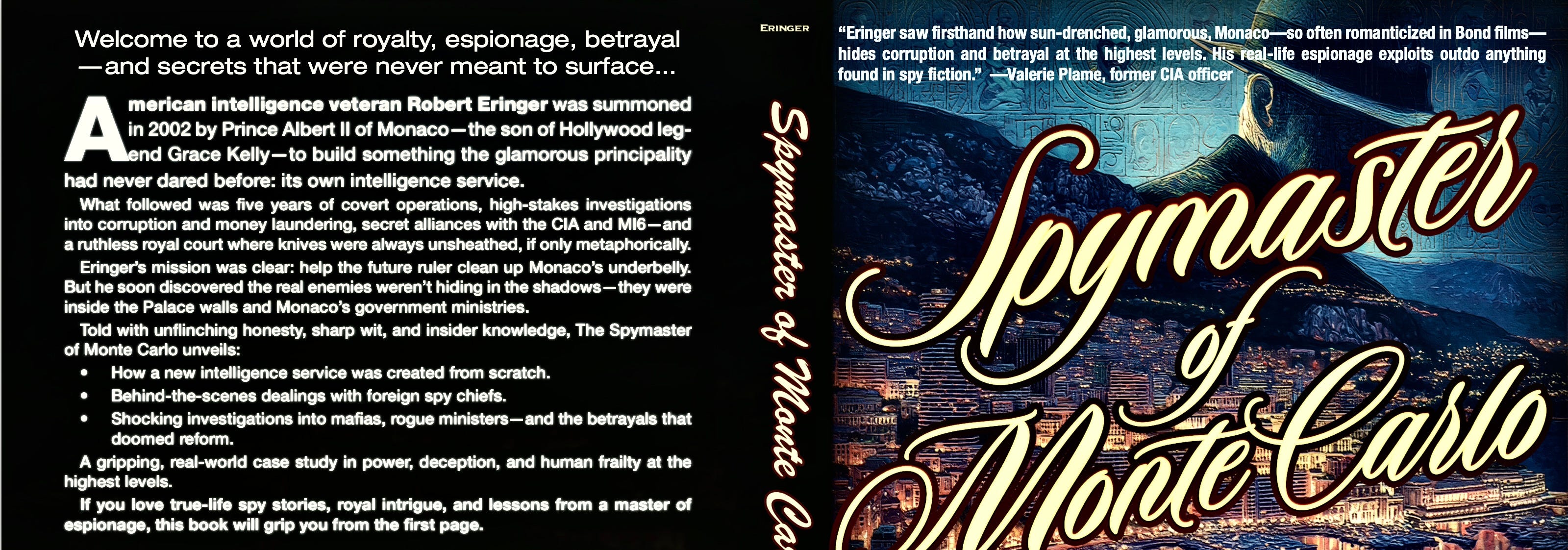

The Spymaster of Monte Carlo, Amazon
Publication: 19 March