

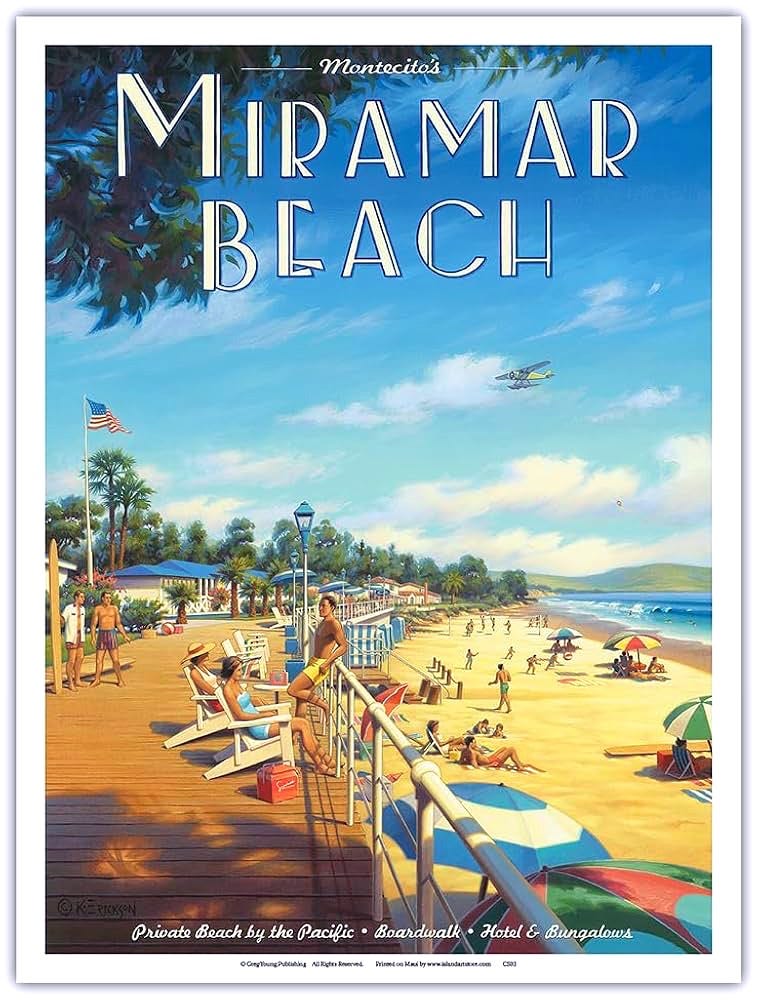
The Miramar burned. It closed. It decayed.
For decades, it stood as Montecito’s most visible contradiction: a prime beachfront property slowly collapsing in public view, while property values everywhere else soared.
Residents drove past it daily. Neighbors complained about it. Real estate agents apologized for it.
The Miramar became more than an eyesore. It was a civic embarrassment.
The First Dream
The Miramar’s roots trace to 1876, when Josiah and Emmeline Doulton purchased a 20-acre stretch of Montecito shoreline from Darius Lyman Bliss and began welcoming guests to what they first called Ocean View Farm—later renamed the Miramar, ‘behold the sea.’”
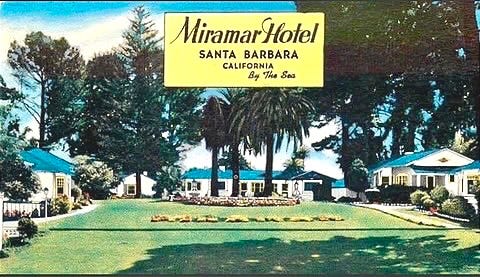
Nothing fancy.
Wooden cottages. Ocean breezes. Simple hospitality.
Guests arrived by carriage and train, seeking fresh air and escape from city heat. The property grew gradually—more rooms, more amenities. And by the early twentieth century, the Miramar had become one of Southern California’s most beloved coastal destinations.
It was casual. Unpretentious. Accessible.
The Golden Years
For much of the twentieth century, the Miramar thrived.
Families vacationed there year after year. Children learned to swim in the surf. Couples celebrated anniversaries in oceanfront rooms. Locals gathered for dinner and dancing.
The hotel was not exclusive. It was welcoming to all.
Where the Biltmore catered to society, the Miramar catered to everyone else—middle-class travelers, vacationing retirees. It offered comfort rather than prestige.
And for decades, that formula worked.
The Slow Decline
Then came the familiar story.
Ownership changed. Maintenance slipped.
By the late twentieth century, the Miramar had begun to age badly. Rooms looked tired. Facilities were outdated. Infrastructure lagged behind modern expectations.
Guests noticed.
So did inspectors.
Enter Ian Schrager, who rose to fame as the co-founder of Studio 54, the legendary Manhattan nightclub that opened in 1977 and quickly became the epicenter of celebrity culture. Movie stars, musicians, fashion icons, and politicians passed through its velvet ropes. The place pulsed with energy, excess, and notoriety.
And eventually, it was shut down.
After legal troubles and a prison sentence for tax evasion in the early 1980s, Schrager reinvented himself as a hotel visionary. He pioneered the concept of the boutique hotel, transforming hospitality into theater, design into identity, and lodging into lifestyle.
By the late 1990s, he was one of the most influential figures in the global hotel industry.
The Miramar had already fallen into decline by the time Schrager arrived in 1998 with grand plans for a stylish resort.
But financial troubles derailed the project, and the hotel closed in 2000.
In 2005, Ty Warner purchased the property, believing he could succeed where Schrager had faltered.
His vision was ambitious: a modern luxury resort that would preserve the Miramar’s charm while elevating it to the level of his other properties—San Ysidro Ranch and the Biltmore.
But Montecito had other ideas.
Neighbors objected. Planning hearings multiplied. Appeals followed.
Warner quickly rediscovered what many developers before and after him learn: building in Montecito can be less an approval process than an endurance test.
Conflicts with neighbors and the complexity of local regulations slowed progress, creating frustration and uncertainty around the project.
At some point, the calculation shifted.
The Miramar was no longer a hospitality project. It had become a political one.
Already fighting to improve The Biltmore and Coral Casino, Ty Warner decided to call it a day.
And so he sold it to LA shopping mall impresario Rick Caruso.
UP NEXT: MIRAMAR PART II