
NEWS REVUE
Think Twice Before You Click the Organ Donor Box

“Public mistrust linked to drop in deceased donor organ donations” (AP)
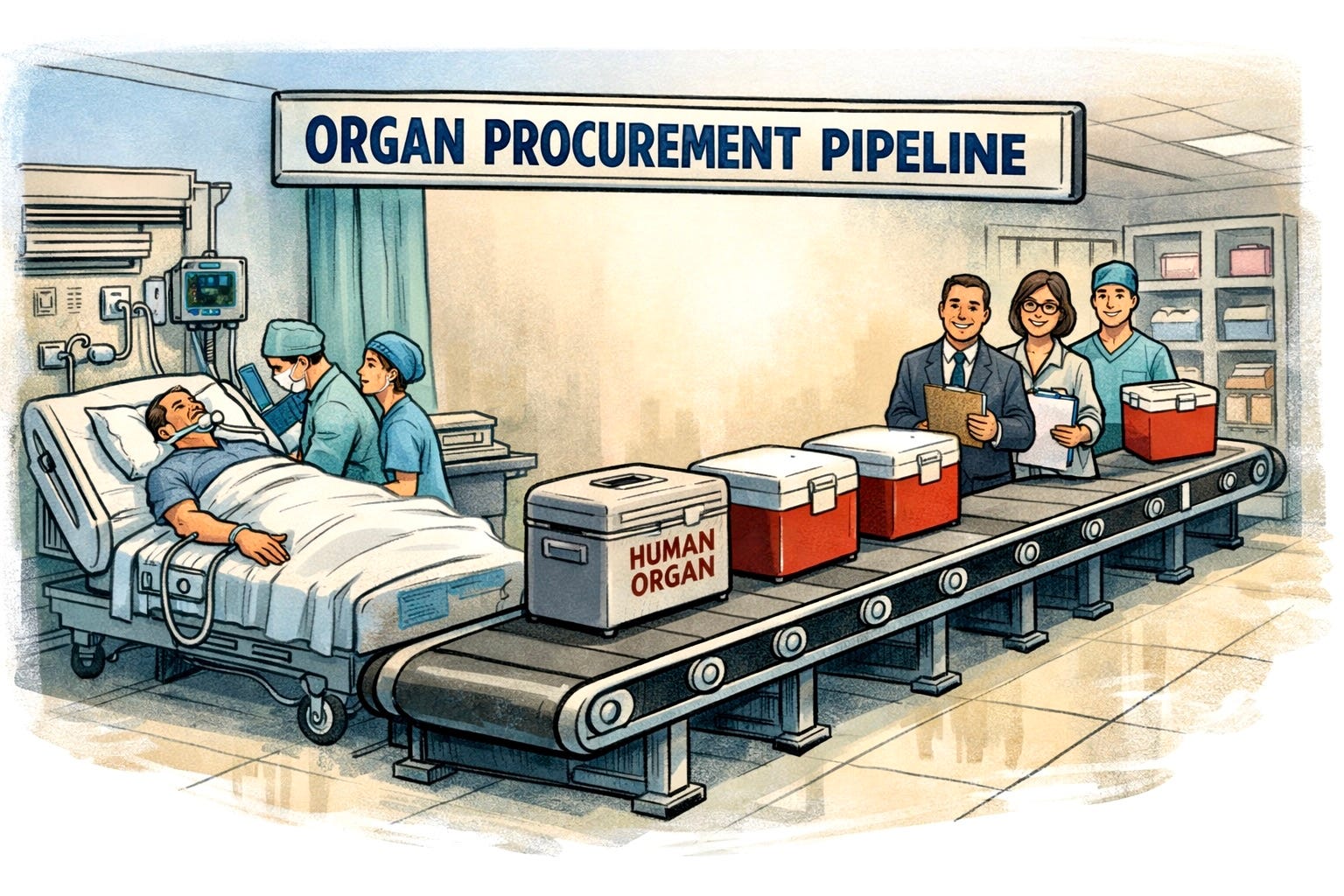
There’s a checkbox most people tick (without even considering the implications) at DMV or online when renewing a driver’s license.
I want to be an organ donor.
It feels civic. Moral. Heroic even.
Trust me, it deserves a closer look.
Yes, it’s true, organ donation saves lives.
What’s also true, but not explained, is that you are entering a system with its own incentives, timelines, definitions, and pressures.
Once you tick that box, you are no longer just a patient.
You are a resource pipeline.
The Problem with “Brain Death”
Organ donation depends on a concept called brain death.
Not cardiac death. Not biological death. Instead, a legal definition introduced largely to enable transplantation.
Brain-dead patients can breathe (with assistance), maintain blood pressure, digest, heal wounds, and gestate fetuses.
Which raises an uncomfortable question: If the body is still fighting to live…
who decides when you’re done?
Answer: If you’re a donor, and you are unconscious, it is not decided by you or your family members. It is decided by committees, protocols, and time-sensitive transplant logistics.
Organs degrade quickly.
That creates pressure to declare death sooner rather than later, prioritizing organ viability while keeping bodies alive enough for harvesting.
Once you’re declared a donor:
Organ procurement organizations enter the room.
Your family’s objections may be overridden.
Hospitals deny this affects treatment. But hospitals also deny billing discrepancies and insurance gaming.
Trust is a gamble. And you are no longer in control of the game.
The hospital can declare you dead, harvest your organs, and profit from the transplant.
Walls are supposed to exist between these functions. They’re paper-thin.
Once consent is pre-authorized, you are no longer negotiating from strength.
The real issue isn’t death. It’s timing.
Would you want one more hour? One more day? One more experimental option?
When organs are on the clock, waiting becomes inconvenient. And you no longer have a say.
Once you tick that box, you are opting into a highly optimized medical supply chain.
The Part They Don’t Like Talking About
Why is the burden of altruism placed on individuals?
Your organs, for free.
Yet this highly organized system:
Charges six figures for transplants (your organs).
Pays executives millions.
Treats your organs as scarce commodities.
Bills insurers accordingly.
If organ donation is pure charity (on your part), why is it so aggressively monetized?
Organ donation is framed as a moral obligation.
But without transparency, it is manipulation.
Before you sign away control, timing, consent, and leverage at the most vulnerable moment of your life, ask yourself one simple question:
When I can no longer speak, do I trust this system to put me first ?
If the answer is anything less than absolutely… you might want to keep that checkbox blank.
“Bill Clinton is risking jail for refusing to answer questions about Epstein. Why?” (The Telegraph)
Why, indeed?
But what’s the big surprise?
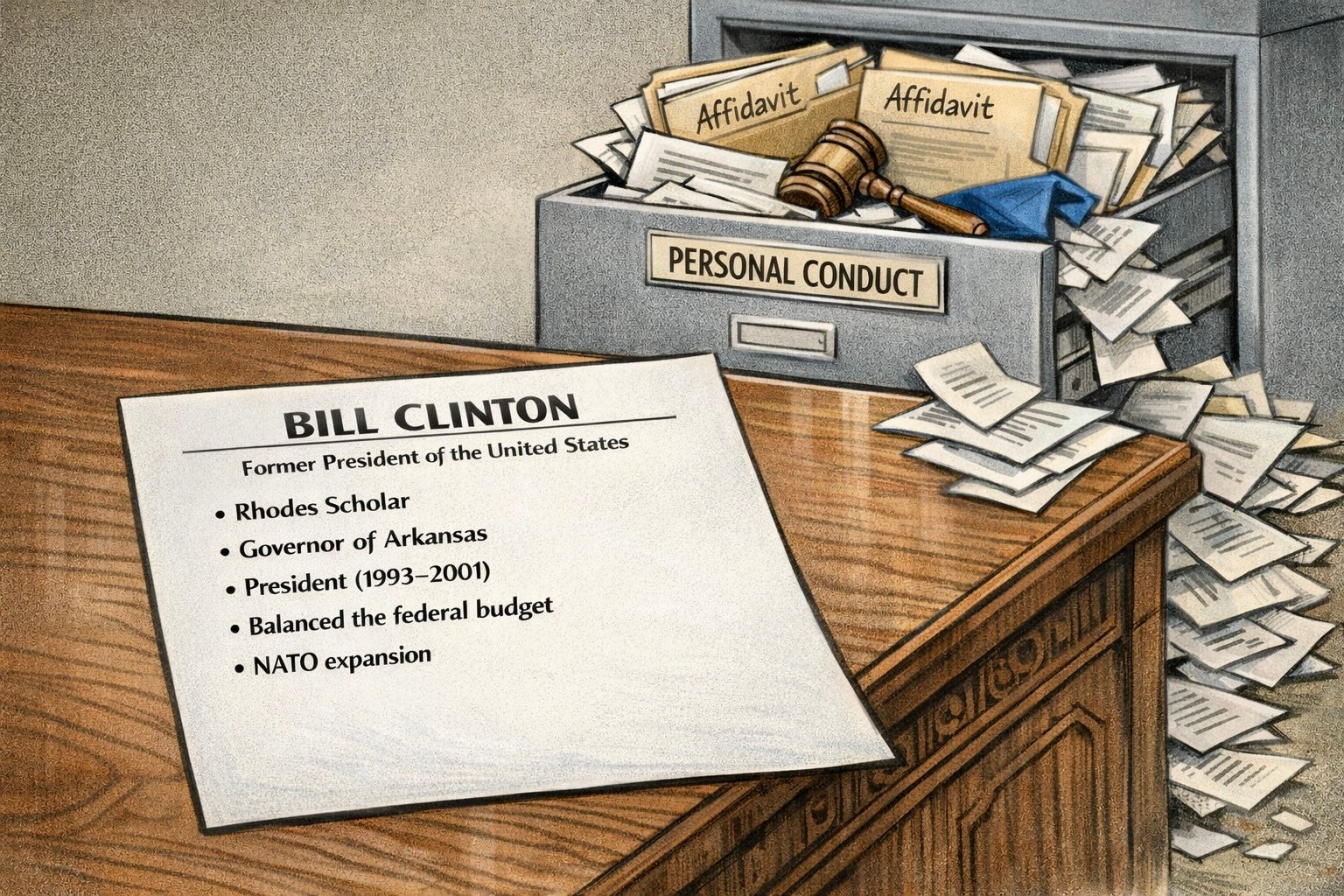
Bubba was impeached for perjury and obstruction of justice because he lied under oath about his 17-month affair with Monica Lewinsky, a White House subordinate who was only 22 years of age when the affair began.
Clinton has a history not only of predatory sexual behavior (Lewinsky, Paula Jones, Jennifer Flowers, others alleged) but also of lying about it.
So why should anyone believe him when he says his relationship with Jeffrey Epstein was harmless?
Even if he says this under oath.
Because Bubba demonstrated for all to see: even after taking an oath, he lies.
“How the CIA weaponized human mind to defeat the Soviets during the Cold War” (Times of India)

The story is real. The language is evasive.
America’s flirtation with mind control didn’t begin with psychics. It began with fear around 70 years ago.
The Korean War jolted Washington with reports of American POWs making scripted confessions. The word then was brainwashing. If minds could be altered, perhaps they could be weaponized. The CIA took the possibility seriously enough to fund research into hypnosis, drugs, behavioral conditioning—what later fell under the broad and notorious umbrella of MKULTRA.
In 1952, Dr. Andrija Puharich, a U.S. Army physician, briefed the Pentagon on extrasensory perception (ESP) and its possible use in psychological warfare.
It didn’t launch a program, but it cracked open something new: the first sanctioned discussion inside the U.S. military of “psi” as a potential intelligence tool.
Through the 1950s and early ’60s, the CIA made scattered, classified inquiries into psychic phenomenon—fragmentary efforts buried inside larger behavioral research. Their work remained fringe until the Cold War provided a jolt.
In 1970, reports surfaced that the Soviet Union was funding “psychotronic” research—ESP, telepathy, psychokinesis. A popular book, Psychic Discoveries Behind the Iron Curtain, amplified the threat. The science was questionable. The reaction was not.
The CIA’s logic was simple: If they’re doing it, we can’t afford not to look.
So the Agency quietly launched Project SCANATE (an acronym for “Scan by Coordinate”) at Stanford Research Institute (SRI) in Menlo Park, California, around 1972-73.
Two laser physicists, Russell Targ and Harold Puthoff, were tasked with testing an uncomfortable idea: could a person describe a distant location using nothing but geographic coordinates?
The CIA tested the idea for ten days. The results surprised them.
The first major target was a classified site in West Virginia. Two independent viewers—blind to the destination—produced sketches and descriptions that matched the building’s layout. One identified interior features. Another referenced codewords associated with the site.
A second target, a sensitive installation inside the USSR, produced results that analysts reported as “too good to be chance.”
The data was inconsistent. The misses were obvious. But the hits—when they came—were solid.
The intelligence community adopted a term designed to keep everyone calm and grounded: anomalous cognition.
SCANATE survived.
And after the CIA dipped a toe into psychic intelligence, the U.S. Army followed.
By the mid-1970s, Army Intelligence launched GONDOLA WISH at Fort Meade, Maryland, testing whether soldiers—not civilian psychics—could remote-view.
Targets shifted from buildings to weapons systems, from geography to intent.
Some sessions produced nonsense. Others produced results that made senior officers uncomfortable enough to keep funding alive.
Next came GRILL FLAME, a joint CIA–Army–DIA program that moved remote viewing from the lab into operations.
Kidnappings. Hostage crises. Missing aircraft. Submarines. Terrorist networks. Soviet weapons hidden from satellites.
Some sessions failed completely. Others produced details analysts couldn’t explain—and couldn’t ignore.
GRILL FLAME morphed into CENTER LANE, then SUN STREAK, each iteration refining protocols, training methods, and secrecy. Controlled Remote Viewing—co-developed by psychic/artist Ingo Swann was standardized.
What began as an experiment became a discipline.
By 1991, all prior incarnations were consolidated into one final container: STARGATE.
For four more years, remote viewers worked out of cramped rooms at Fort Meade.
Then, in 1995, the CIA ordered a comprehensive review.
The conclusion was carefully worded: the statistics were “interesting,” but the method was “not operationally useful.”
STARGATE was officially shut down.
But was it really?
Successful programs rarely die. They just change the sign on the door with a new level of classification.
Which brings us to the present.
The Times of India article concludes with this passage:
How the CIA weaponized Human Mind...
The research didn’t entirely stop. Interest in psychic phenomenon didn’t disappear.
In 2014, the Office of Naval Research launched a four-year $3.85 million program exploring intuition and premonition.
“Intuition” means information arriving before analysis catches up.
“Premonition” means awareness before causation is visible.
Which, of course, is extra-sensory perception (ESP), stripped of ESP.
Nothing changed except the vocabulary.
The U.S. government didn’t abandon psychic research.
It sanitized it.
"If you recall, sir, the Union felt that 'Brain Death' might prejudice the status of their living members"
https://www.youtube.com/watch?v=1Bq_abof4lg