

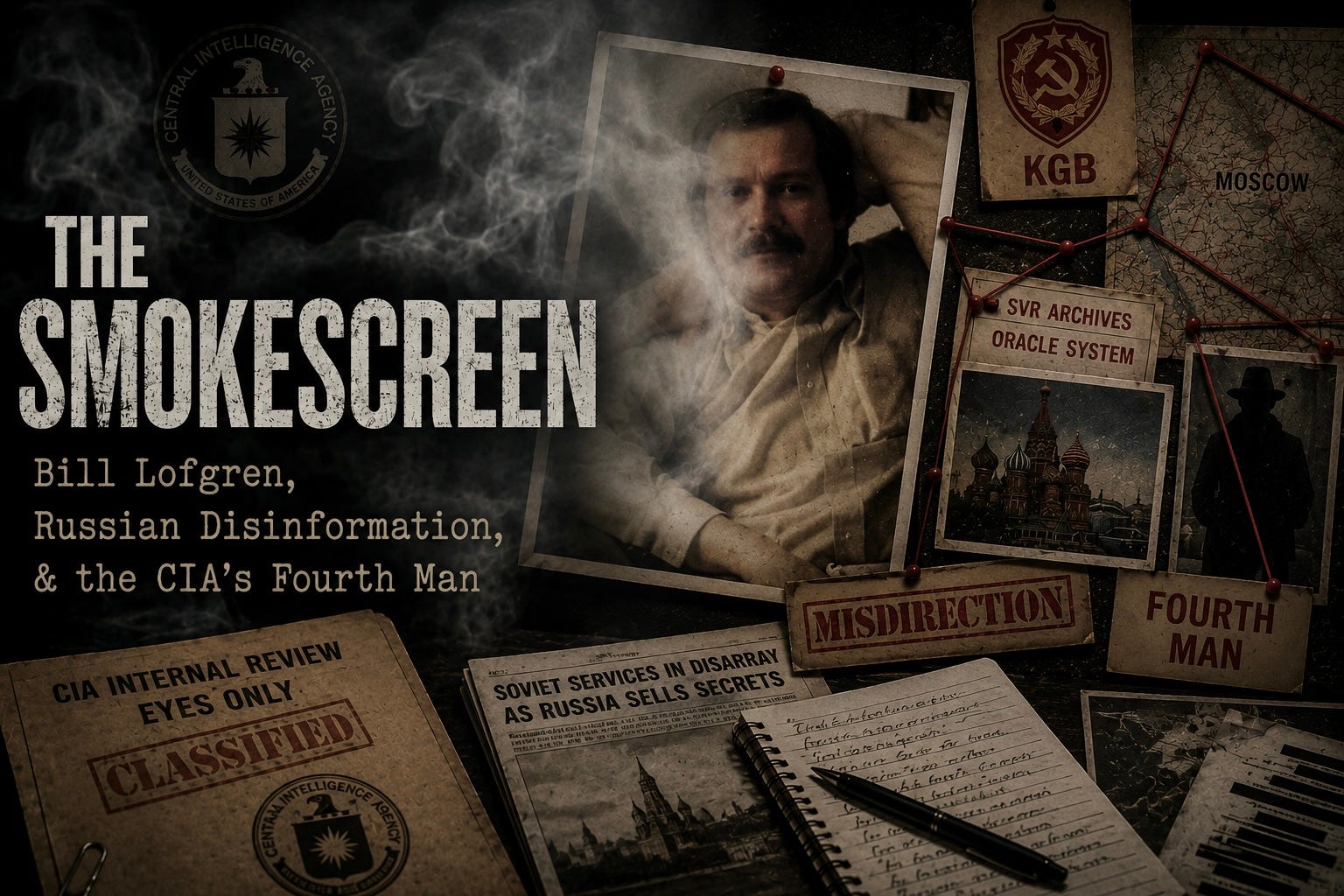
“Former CIA Counterintelligence Chiefs Weigh in on The Fourth Man” (The Cipher Brief)
This Cipher Brief article from 2023 focuses on Robert Baer’s book The Fourth Man and advances the premise that retired CIA Counterintelligence Chief Paul Redmond was not a Russian spy.
I agree.
Paul Redmond served the United States with distinction throughout a highly accomplished CIA career.
But let’s examine the seventh paragraph of this lengthy piece:
“Mr. Baer reveals that he was persuaded in 2019 (23 years later) to write the book by his one-time CIA Division Chief, who is one of his key CIA sources. This raises interesting questions about motivation. His former boss, Baer writes, ‘would come around to proposing I blow the dust off the Fourth Man investigation and see what I could do to restore it to life.’”
Curiously, the authors never bother to identify the instigator, i.e., the CIA Division Chief who prodded Baer into resurrecting the allegation against Paul Redmond. Nor do they examine why this CIA Division Chief was so intent on reviving it, even though, they correctly state, it “raises interesting questions about motivation.”
They know who he is.
Revealing his name would not have compromised sensitive information; it is already in the public domain.
Yet they neglected the most obvious question: What did this individual—this former CIA division chief—stand to gain by hiding behind Bob Baer to point a finger at Paul Redmond? And why was he so determined to persuade Baer to do the dirty?
Let’s fill that gap and examine what the authors—representatives of the intelligence community—chose to sidestep.
One of the more curious episodes during my tenure as Prince Albert’s spymaster in Monaco (2002-07) was a Russia-based spy-net we codenamed The Oracle System.
It came to us through William Lofgren, a senior officer of the CIA’s clandestine service who’d retired after a career spanning 26 years, capped as chief of the Eurasia Desk, which oversaw espionage operations against Russia. Like many agency veterans, Lofgren had ventured into private-sector intelligence work, exploiting his old CIA sources for corporate clients.
In the late 1990s, President Boris Yeltsin’s Russian intelligence services were in disarray. Morale was low; greed was high. Government sectors, including the SVR, scrambled to cash out. Lofgren claimed he had leveraged this environment to open a window into SVR archives through a Russian facilitator who (we assumed) had defected to the USA after many years operating as a double-agent for the CIA and now ran his own clandestine spy-net inside Moscow.
According to Lofgren, his network could access specific SVR files, memorize their content, and pass it along in carefully sanitized reports. No photocopies. no photos. Only notes—typed up, smuggled out, and hand-delivered by Lofgren himself.
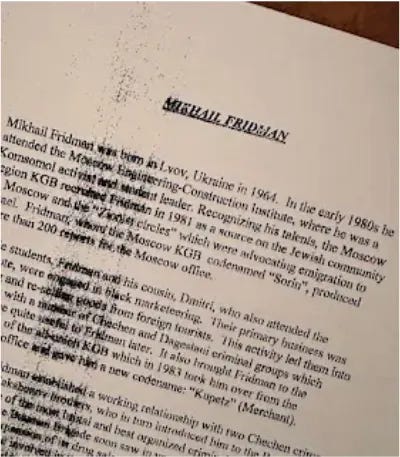
A few years before my formal commission with Prince Albert started, former CIA spymaster Clair George and I had tested the system with a simple tasking from the prince: an inquiry into a Serbian resident of ill repute living in Monaco. The report we received at the prince's expense was impressively detailed.
Lofgren was adamant about one thing: no probing questions. His network’s survival depended on airtight secrecy. If we insisted on knowing more, Bill warned, he would sever ties immediately. Out of deference to Clair George’s high regard for him, and because of Lofgren’s résumé, I accepted these terms.
In hindsight, this was a huge mistake.
Not because Lofgren’s behavior violated standard CIA ethics by continued contact with foreign agency assets, though this speaks to Lofgren’s character.
It was a mistake to use Lofgren and his Oracle System for more serious reasons.
First some context:
Lofgren left the agency amid a contentious relationship with CIA Director George Tenet. The story went like this: Lofgren was traveling in a government jet with Tenet and, high above the Caucasus, the plane took a deep dive and, recounting the event later, Bill told a colleague, “I thought I was about to die and the last thing I’d see is that Greek prick.” It soon got played back to the director.
Morale was almost as low at CIA as it was among the Russian services. The Cold War had supposedly ended and 9/11 had not yet happened to reenergize the agency for its new mission: to crush Islamic terrorism.
Career senior officers were departing, and they were leaving on less than good terms after the very acrimonious directorship of John Deutch.
Now back to Lofgren: The problem with operating independently—as former agency officials endeavor to do in the private-sector—raw intelligence does not go through the arduous process of vetting and validation.
By insisting we not question the veracity of the “intelligence” he produced, Lofgren created the perfect shield for assuring he wouldn’t get caught out.
Sadly, new information coming in over the years strongly suggests that we (and presumably other Lofgren clients) were swindled with a false bill of goods.
Instead of raiding SVR files (if such a system ever truly existed), Lofgren and his support team were mixing open source information with fabricated nonsense.
But it gets worse.
New evidence since then suggests that something more than insatiable greed and laziness had been taking place.
Something that leads to this nagging question: Did Bill Lofgren do this merely to enrich himself with the hundreds of thousands of dollars he dishonestly received for “intelligence reporting”—or was he deliberately planting disinformation on behalf of the Russian intelligence services?
It may have all started with something rotten in the state of Denmark.
Literally.
William Lofgren was chief of station in Copenhagen in 1979 when (“accidentally,” it is said, after supposedly drinking too much vodka at a Russian embassy diplomatic event) he revealed to the KGB rezidentura the identity of a valued CIA asset.
Consequently, Polish-born Boris Korczak (the asset), needed to be relocated to the USA for his own protection.
But even after Korczak’s life was directly threatened by menacing KGB officers, Lofgren dragged his feet over getting him out quickly.
Boris’s son, Robert Korczak, told me: “My dad had three CIA handlers, the last of which was Bill Lofgren. He was a liar and a cheat. Strange things started happening after his arrival. Lots of our family possessions were taken by him including four shopping bags filled with chunks of beautiful golden amber and assorted antiques from our house. Bill also demanded a large part of my dad’s Russian icon collection in exchange for ‘expediting’ our relocation to the USA. Years later my dad explained to me that Bill was essentially shaking him down. Lofgren acted as though the Agency had sent him out to get rich off other people’s sweat. He was also reckless. My dad’s previous handlers were discreet in their dealings with him. But Lofgren would pull up in our driveway. He was also a drinker, perhaps a functional alcoholic. It wouldn’t shock me or my dad if he had been working for the Russians all along.”
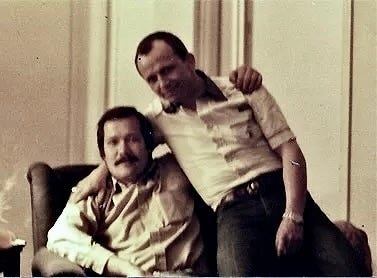
Fast forward from Denmark in 1979 to 2002, when Lofgren delivered to Clair George and me an Oracle System report—supposedly from SVR archives—on two Monaco-based brothers.
It is now abundantly clear that the “intelligence” provided by Lofgren was false, i.e., disinformation fabricated by Russian intelligence who sought to defame two brothers who had presumably run afoul of Russian intelligence and their corporate accomplices.
So: Was Lofgren an unwitting useful tool/fool—or an intentional asset of the Russians?
More important—as evidenced by the grief Boris Korczak suffered at Lofgren’s hands—an additional question needs to be asked:
Was Bill Lofgren recruited by the KGB in Copenhagen in 1979?
If the answer is yes, the damage done to the USA would have been immense.
In the aftermath of discovering Aldrich Ames and Robert Hansen as Russian spies, the CIA embarked on a collaborative endeavor with the FBI. Together they established an investigative unit tasked to determine if they had yet another spy—a “fourth man”—in their midst.
This concerted effort was motivated by a series of perplexing incidents that defied explanation and predated the cases of Edward Lee Howard, Ames and Hanssen and therefore could not be attributed to the treacherous trio.
By delving into these otherwise inexplicable cases, the newly formed investigative unit aimed to trace the origins of those compromised and identify potential moles that had evaded detection.
The unit concluded that another spy—a “fourth man”—most certainly existed. This conviction was founded upon a meticulous analysis employing an access-and-timescale matrix, which cast a spotlight on a select group of senior CIA officers.
However, despite the weight of suspicion, no arrests were ever made, a veil of silence was cast over its endeavors, and the unit was ordered to close down as quietly as it had been assembled.
Bill Lofgren was among those who fit into the matrix.
And, yes, it was Bill Lofgren who persuaded Bob Baer to write a book that redirected suspicion away from himself.
Back to Monaco—but first to my earlier experience operating undercover for FBI Counterintelligence through the 1990s.
My main mission was to orchestrate the rendition of Edward Lee Howard, the only CIA officer ever to defect to the Soviet Union. Posing as the editor of the book he was writing, it was my job to get Howard to answer multiple questions “for the book.”
Howard revealed to me that a few years after his defection to Moscow (in September 1985) he returned to the USA using a fake U.S. passport (supplied by the KGB) in the name of Scott A. Roth.
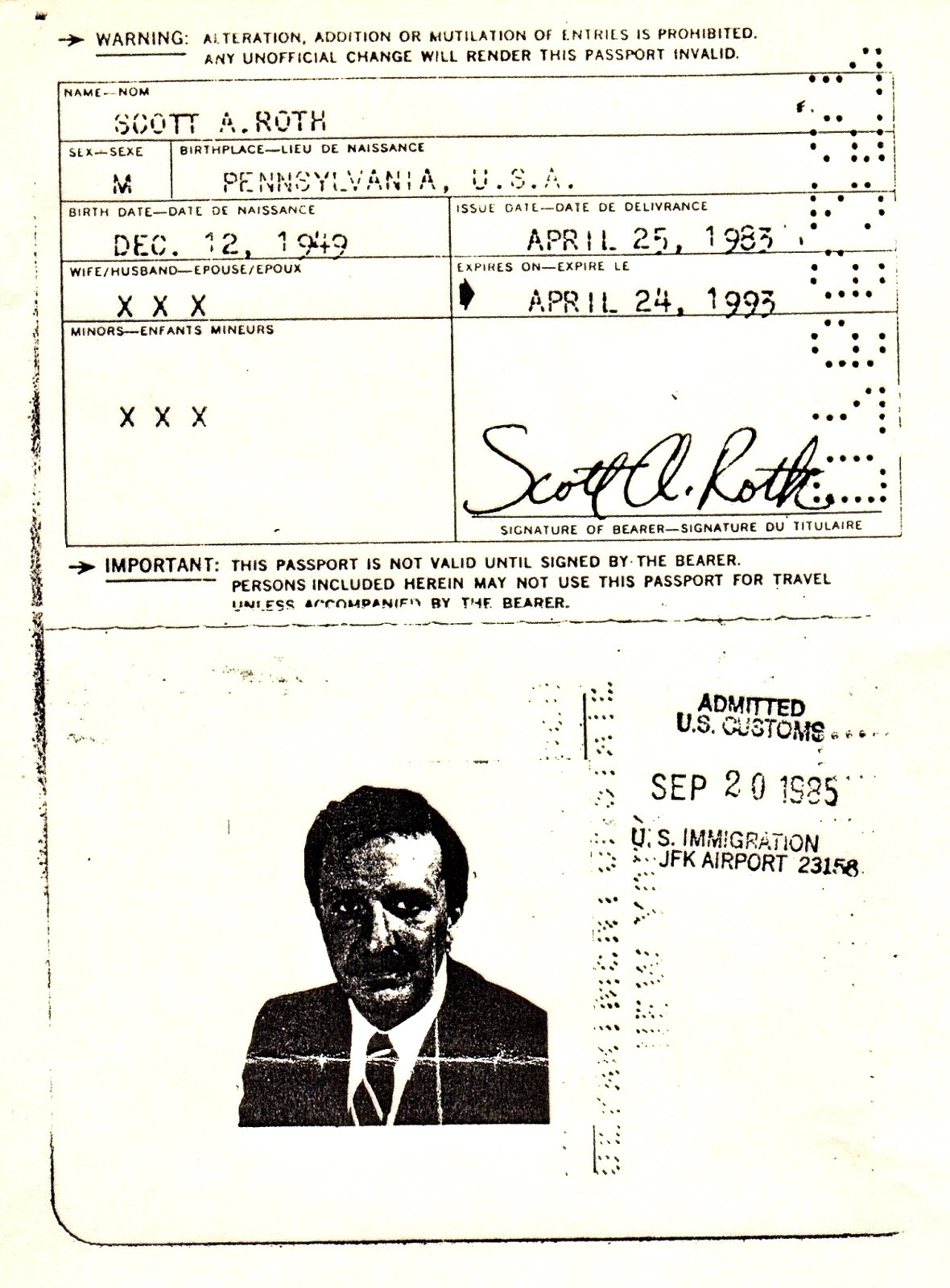
He was homesick and wished to reconnect with his wife, Mary. Howard’s first stop, before attempting to contact Mary, was Washington, D.C. The KGB arranged for him to be met on a park bench by an American intelligence official who warned him, based on classified intelligence, that Mary had begun to secretly cooperate with the FBI and that if he tried to contact her he would most certainly be captured. Howard went no further and returned to Moscow.
More importantly, Howard told me that the American intelligence official who met him was neither Aldrich Ames nor Robert Hanssen. Granted, it might have been an illegal or sleeper agent planted in the USA by the Russian General Directorate for Special Programs.
I suggested this to Howard.
It evoked an amused smirk and this question: “You think the Russians don’t have other spies inside the agency?”
Ed Howard later introduced me to former KGB Chairman Vladimir Kryuchkov, who wished to publish his own memoirs in the USA. Again, operating undercover for FBI Counterintelligence, I obliged Kryuchkov and, equipped with a “shopping list” of questions to which our own Russia analysts wanted answers. I coaxed Kryuchkov to help resolve an espionage mystery or two under the presence of being able to better market and publicize his book.
Thus, the KGB chairman sat for hours in my room at Hotel Baltschug-Kempinski, across the Moskva River from the Kremlin, as I quizzed him on a wide spectrum of topics.
Although mostly hesitant, Kryuchkov did come through occasionally with what his associate (and translator) KGB Colonel Igor Prelin called a “silver bullet.”
My question to Chairman Kryuchkov: Why didn’t the KGB do anything to rescue their valuable mole Rick Ames when they knew he was suspected of selling CIA secrets to the Soviet Union?
It was a trick question. We did not know if the KGB was aware of the Ames investigation. But the otherwise stony-faced bureaucratic apparatchik finally showed some real emotion. “We knew!” the former chairman blurted. “We wanted to get him out of USA! We proposed this, it went all the way up to [Russian President Boris] Yeltsin! And Yeltsin says NO! We should have got him out!”
I could feel the passion and disgust in Kryuchkov’s voice.
Stunned by this revelation, my natural follow-up question was “Why did Yeltsin say nyet?”
Kryuchkov irritably explained that Yeltsin believed it would upset the applecart, specifically, the $1.6 billion U.S. aid package promised to him by President Clinton.
The point here is that the KGB knew Ames was in trouble.
How did they know?
Possibly from Robert Hanssen.
Or a fourth man.
Now back to Monaco and, as Prince Albert’s spymaster, my utilization of Bill Lofgren’s Oracle System.
Lofgren at some point initiated an attempt to convince us that a Russian mole existed near the top of MI6 on the assumption that we would notify them. This is a classic ploy by Russian intelligence to gum up the works of adversarial intelligence services by causing unnecessary witch hunts. In this case, the ploy failed because Lofgren’s claim could not be validated and was prudently dismissed.
And then there was the retired U.S.Air Force colonel we codenamed MING, suspected of spying for the Russians.
Lofgren and his Oracle System provided (at high cost) incredible information. In fact, not credible at all, and perhaps designed to hinder our investigation. We disregarded the report because it did not jibe with what we knew to be true. Worse, Lofgren— and his KGB associates, if he told them— became privy to the FBI opening an official investigation based on our intelligence.
To the best of my knowledge, our suspect colonel has not been seen or heard since he sold his Malibu mansion in 2005. Did the Russians, after learning of the investigation, lure him back and make him “disappear”? It would not surprise me.
Back to Ed Howard: in July 2002 Edward Lee Howard met the grim reaper in Moscow (he supposedly tripped and broke his neck) after Lofgren learned from me about a renewed effort by FBI Counterintelligence to rendition Howard and repatriate him to face American justice.
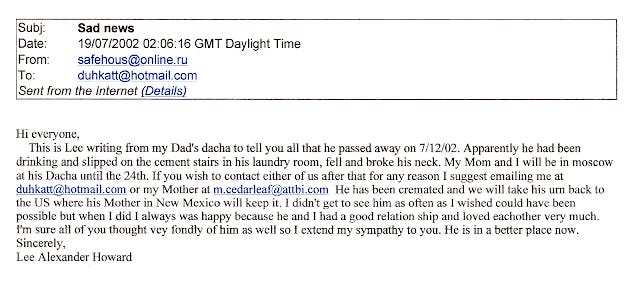
Russian intelligence could not allow Howard to return to the USA, under any circumstances. In all likelihood, Howard was murdered. And his murder was covered up by a very hasty cremation.
Now back to Lofgren: Perhaps most revealing of all, a former private-sector associate of his told me about a discussion Lofgren initiated in 2005. Bill wanted to know a foolproof way for surreptitiously transferring a substantial amount of money from overseas to an account he could access in the USA.
Such a question smacks of money laundering, tax evasion, undeclared foreign bank accounts… and… espionage.
In intelligence work, isolated incidents mean little.
Patterns mean everything.
What I have laid out here is not a verdict, but a pattern: unethical behavior, fraud, disinformation, suspicious timing, compromised judgment, firsthand encounters, and lingering questions that were never satisfactorily answered.
Perhaps all of this is coincidence.
Perhaps Bill Lofgren was merely reckless, greedy, and catastrophically unreliable.
Perhaps.
But after decades spent inside the strange theater of espionage, I have learned that institutions often reveal themselves less by what they pursue than by what they quietly avoid.
What I present here is an accumulation of operational experiences and unanswered questions that certain intelligence circles seem curiously unwilling to confront.
It is said he is extremely unwell with Lewy Body Dementia.
A google search shows Lofgren is still very much around.