
STRIKE FOR FREEDOM!
The Story of Lech Wałęsa & Polish Solidarity

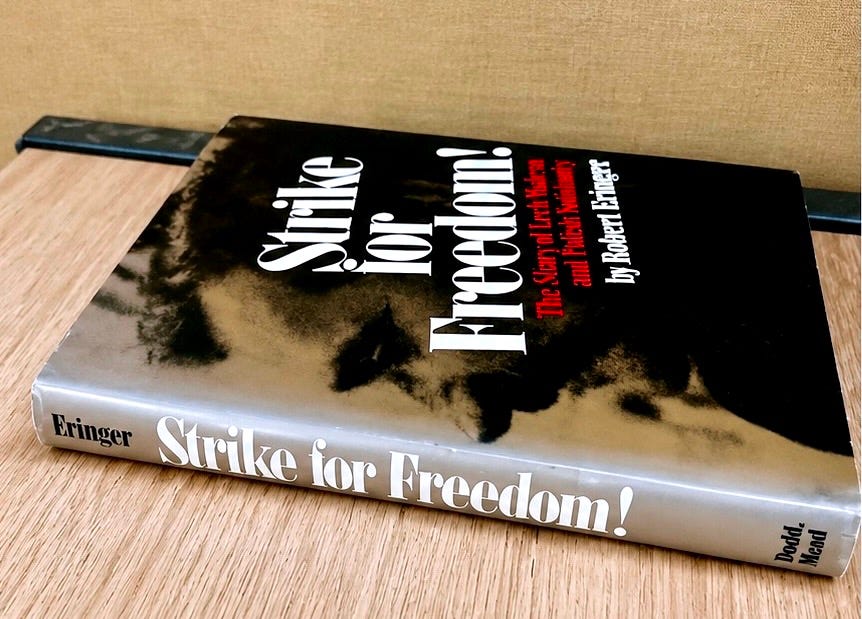
As noted last week, The Global Manipulators appeared in 1980.
It was the last book Pentacle Books ever published.
Two years later, Dodd, Mead & Co.—a venerable New York publishing house founded in 1839—published one of the earliest American books devoted to Lech Wałęsa and Polish Solidarity.
At the invitation of Polish radio journalist Rafał Brzeski, who had discovered my Bilderberg book after seeing it advertised in The Economist, I traveled to Poland and inserted myself into his world.
The result was Strike for Freedom!
Rafał co-authored the book but declined to be named, fearing repercussions from Poland’s secret police after General Wojciech Jaruzelski imposed martial law and forced Solidarity underground.
When the book appeared in 1982, nobody knew how the story would end.
Wałęsa was under detention. Solidarity had been outlawed. Martial law was in force. The Soviet Empire still looked permanent.
History, however, had other plans.
Within a decade, Wałęsa would receive the Nobel Peace Prize, Solidarity would emerge victorious, the Berlin Wall would fall, and the Soviet Union itself would cease to exist.
There was no internet in the early ‘80s. Opposition movements relied on paper, mimeograph machines, clandestine printing presses, and trusted couriers.
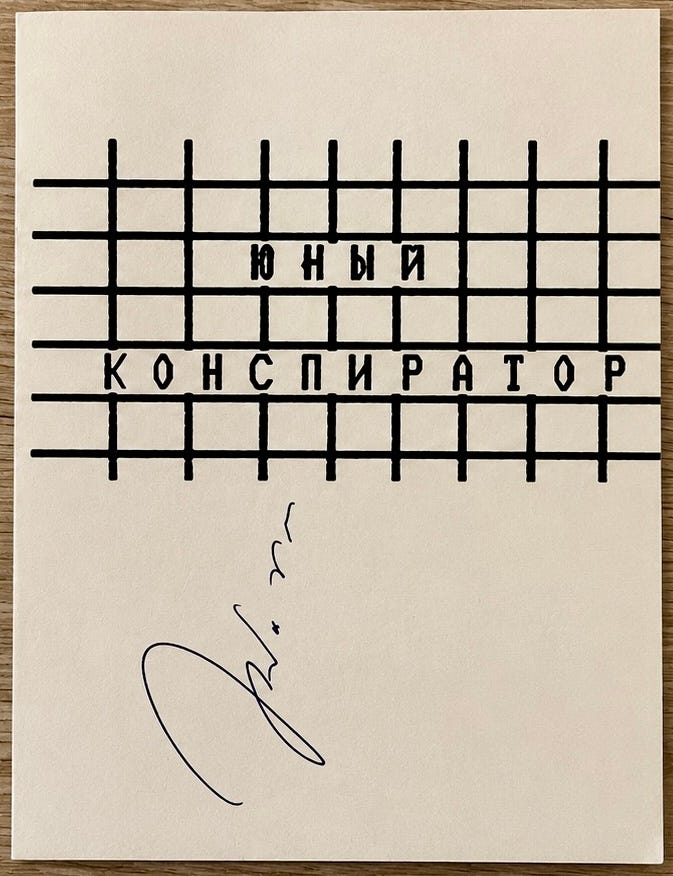
To that end, Rafał and I arranged for The Little Conspirator to be printed in Polish and distributed throughout the country.
It was practical handbook on how to operate underground, avoid detection, and—if caught by the U.B., Poland’s secret police—how to deal with summonses, searches, detention, and interrogation.
Here is an excerpt from a chapter entitled Notebooks.
“It is forbidden for anyone in the underground to have an address book, not in your apartment or on your person. It is the policeman’s duty to check every person and every address they find. The results of a police investigation of what you thought was an innocent address can sometimes be surprising.”
Everything was covered in this manual: avoiding telephones, dead-drops, secret compartments, surveillance detection, clandestine communications, and underground publishing.
It remains a unique document, never published in English.
Just one of a number of irregular acquisitions in my cabinet.
Perhaps a series one day: What’s On My Shelves.
Every object is a portal to an extraordinary story.
As for The Little Conspirator, its immediate purpose was practical.
Authoritarian systems depend upon the belief that resistance is futile.
This little booklet suggested otherwise.
It reminded people that resistance still existed, that others were continuing the struggle, and that opposition remained possible even under martial law.
Lech Wałęsa signed my copy.
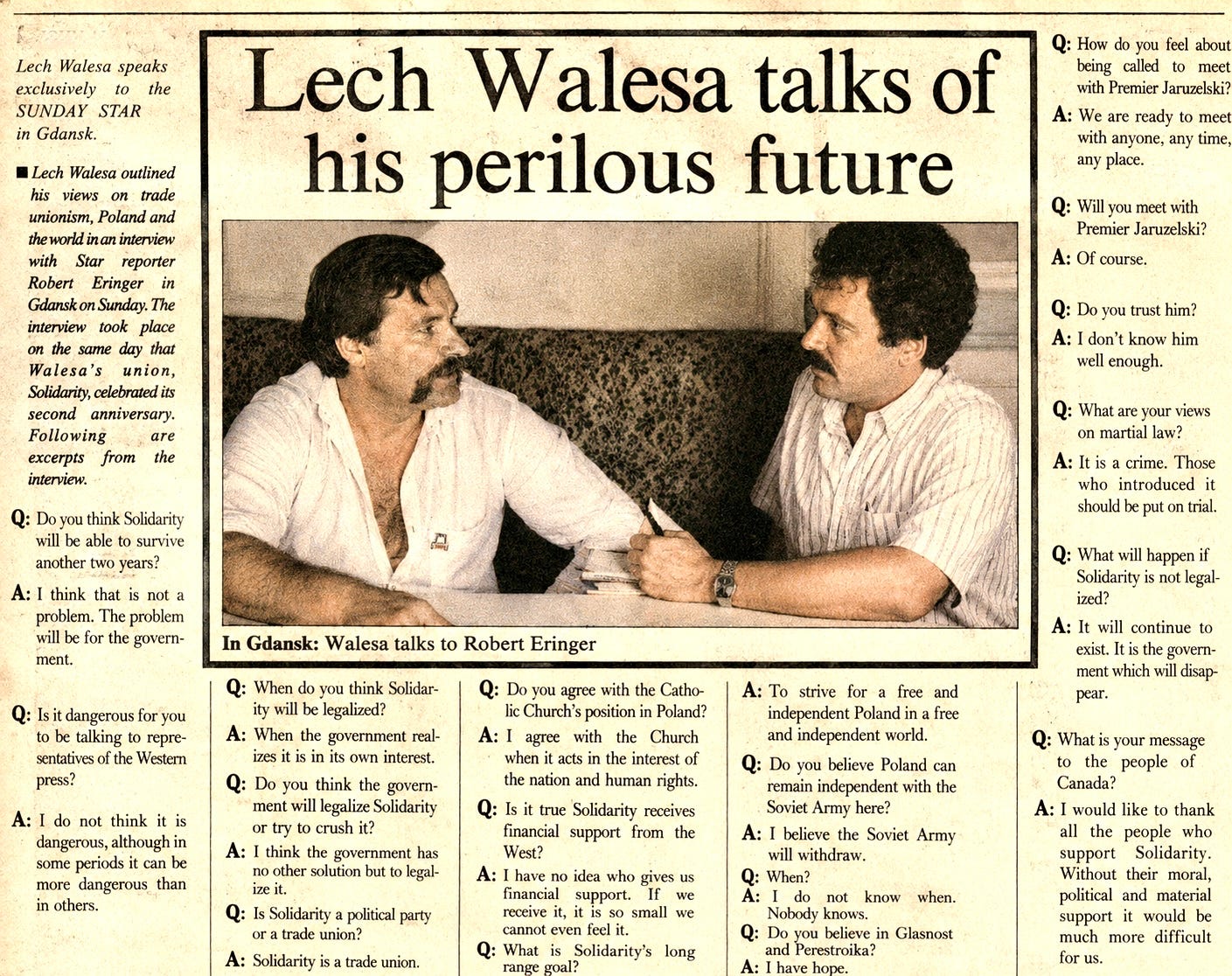
I’d returned to Poland in 1984 to interview Wałęsa at his home in Gdansk, where he was under house arrest. (The S.B. officer doing surveillance of his apartment building was not very welcoming. Upon my arrival at the Wałęsa residence, he snarled something in Polish like “We’ll fix you.” But I didn’t need fixing.)
The interview appeared simultaneously in the Toronto Star, Toledo Blade and the (UK) Sunday Mirror.
Many intelligence professionals regard Solidarność as the beginning of the end of Soviet domination in Eastern Europe. The movement exposed a truth that authoritarian systems prefer to keep hidden: once enough people stop pretending, the machinery begins to wobble.
It is also widely believed that Solidarity’s survival depended upon a remarkable alliance of interests. The Vatican under Poland’s Pope John Paul II provided moral authority and encouragement. Western trade unions provided assistance. American intelligence supplied money and logistical support.
TIME magazine’s famous 1992 article, “The Holy Alliance,” described a covert collaboration involving the CIA, the Vatican, and other Western supporters determined to keep Solidarity alive.
Wałęsa himself later said that without John Paul II’s words and presence, Solidarity would never have been born.
One final footnote.
While Strike for Freedom! was being prepared for publication, Dodd, Mead was sold.
By decade’s end, Dodd, Mead ceased to exist.
A recurring theme of my publishing career is that publishers often seem to have a shorter life expectancy than the subjects I write about.
The Soviet Empire soon followed it into extinction, where it belonged.
Does this sound anything like Russia, China, Iran, Cuba, Afghanistan, etc? "Wałęsa was under detention. Solidarity had been outlawed. Martial law was in force. The Soviet Empire still looked permanent."
Mr. Eringer's comment "Many intelligence professionals regard Solidarność as the beginning of the end of Soviet domination in Eastern Europe." is prophetic for the fast crashing State of Calif. and its now 40 years of one party rule?
Does anyone find the really harsh political statements dragging in the mud Capitalist, the same type of comments being thrown around in Maine, Sacramento, Frisco, and L.A. to be dangerous?
Perhaps it is time for a new book, looking solely at the State of Calif.
Good post.