

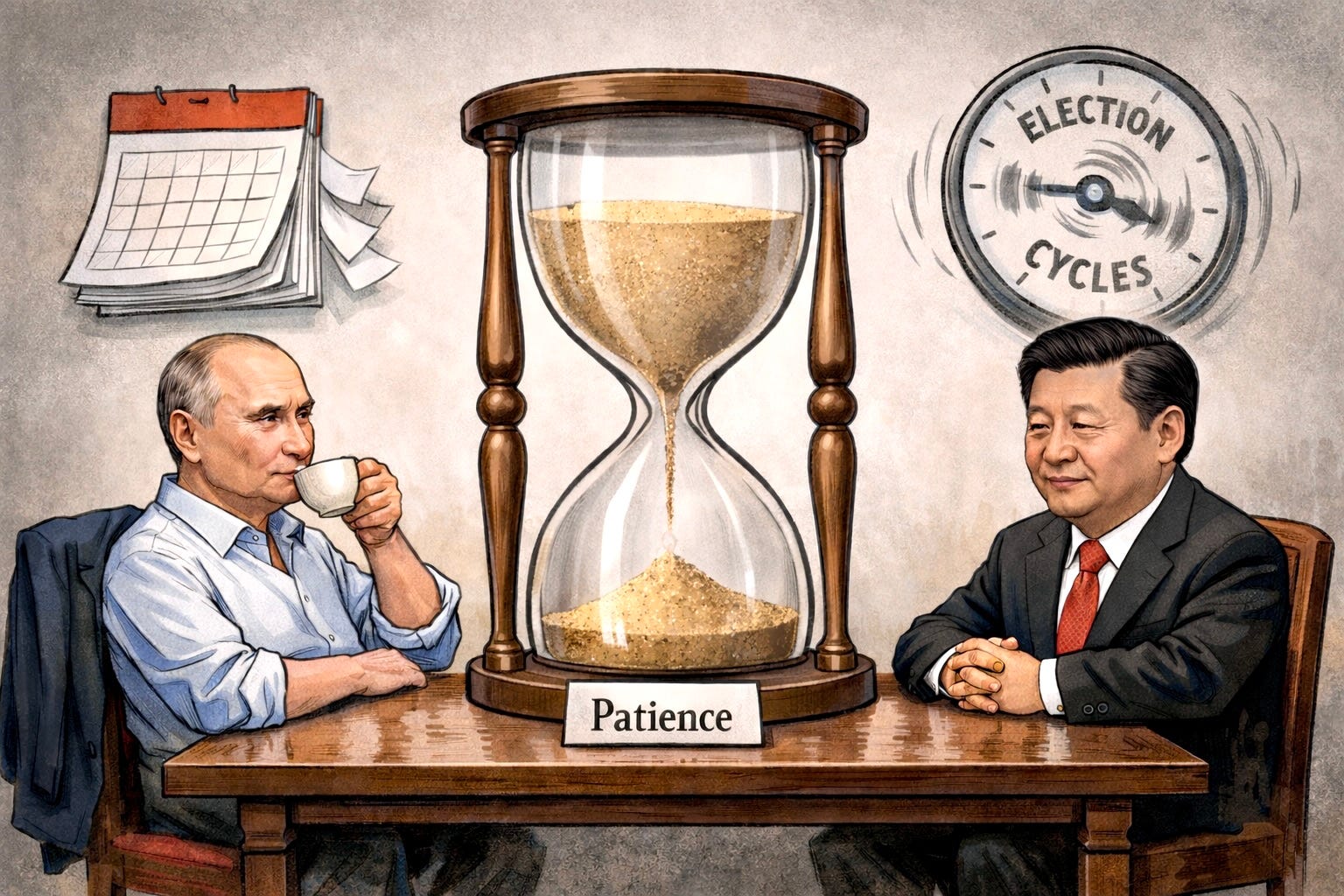
Time favors autocrats.
Right now, both Vladimir Putin and Xi Jinping are unhappy campers.
Donald Trump is back. He’s disruptive. Transactional. Unpredictable.
He doesn’t read from the script and he doesn’t respect established protocols.
Trump disrupts preferred rhythm. He refuses tidy ladders. He treats geopolitics like real estate—location, leverage, walk-away power. That’s annoying to men who prefer chessboards with fixed rules and long-rehearsed moves.
But neither Moscow nor Beijing is panicking.
They don’t need to be.
Trump is temporary.
Three years is a blink in imperial time.
Putin has ruled Russia for a quarter-century. Xi can rule China for life.
Putin and Xi measure power the way cathedrals are built—stone by stone, generation by generation, with no hurry and no apology.
So what do they do while Trump is in the White House?
They pedal softly.
No dramatic escalations. No chest-thumping. Instead, they placate. Compliment Trump. Offer deals that go nowhere. Nod solemnly in photo ops. Issue statements that say everything and commit to nothing.
It looks like passivity.
It isn’t.
It’s patience weaponized.
Putin understands he’s not trying to win Trump. He’s trying to outlast him.
Xi thinks even longer. China doesn’t do election cycles; it does dynasties.
To Beijing and Moscow, Trump is a passing inconvenience, not an existential threat.
So China absorbs the shock, reroutes trade, deepens non-dollar arrangements, and keeps building infrastructure alliances while Washington argues with itself on cable news.
Putin doesn’t escalate Ukraine beyond what it can sustain.
Xi doesn’t provoke Taiwan beyond routine pressure.
They don’t poke Trump in ways that force an unpredictable response.
They play defense, consolidate gains—and take notes.
Smile now. Strike later.
American power is loud. It announces itself. It craves validation. It changes tone every four years and strategy every eight. Adversaries don’t need to defeat that system outright.
They just need to let it trip over its own shoelaces.
Putin and Xi (and other autocrats) assume that once Trump leaves office America will revert to process, back to predictability.
That’s when their real moves begin.
The question isn’t whether Putin and Xi are playing a long game.
They are.
The question is whether America is playing any game longer than its next election—
while its adversaries privately laugh at, and nudge along, its domestic squabbles.
How to Counter the Long-Game
Only one president in modern U.S. history fully understood the long-game—and how to counter it.
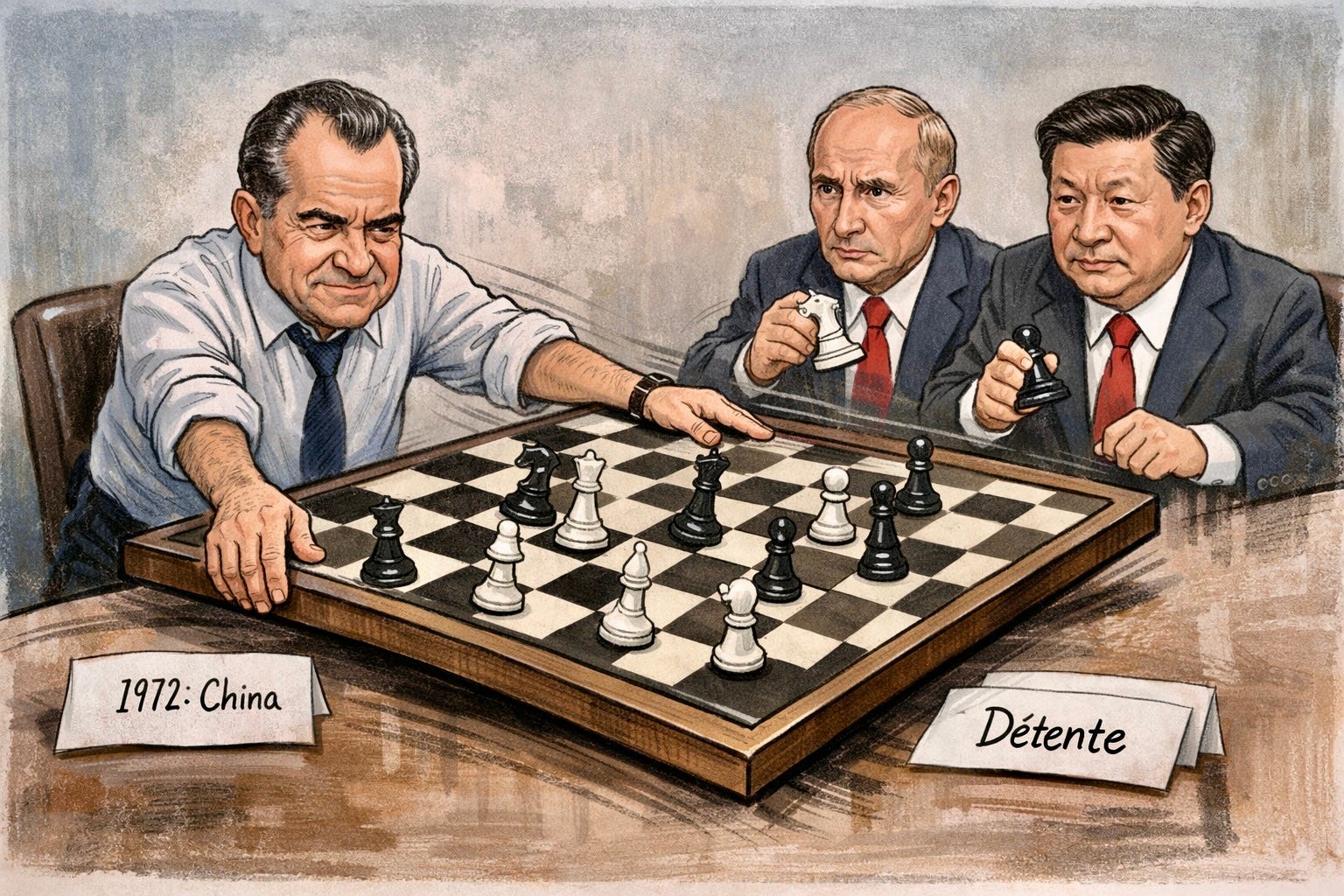
That was Richard Nixon.
Nixon didn’t strategize foreign policy with the help of Georgetown salons or Aspen panels. He didn’t seek permission from the Council on Foreign Relations. He focused on leverage and outcomes—and he thought long-term.
Nixon’s strategy was to out-fox America’s adversaries, quietly, in a way that would prevail beyond his term. He understood that the only way to defeat long-game players is by changing the board.
First, he split them. Nixon believed adversaries should never be allowed to align comfortably. That was the genius behind opening China in 1972—not because he trusted Beijing, but because he used it to unnerve Moscow. At the same time he pursued detente with the Soviet Union, leading to significant arms control treaties.
Second, Nixon was unpredictable structurally, not emotionally. His so-called “madman theory” was disciplined ambiguity. The point wasn’t to appear reckless; it was to force adversaries to assume you might be.
Third, Nixon thought in decades. Not terms. He asked where power would consolidate long after today’s arguments had burned out. Where would China be in 20 years? So he aimed policy at locking in structures that would survive administrations; alliances hard to unwind, commitments embedded too deeply to reverse.
Nixon didn’t fail because this thinking was wrong. He failed because he threatened entrenched interests—and because his own paranoia handed his enemies the opening they needed.
Regarding Nixon, he had the answer to China, Vietnam, and the Soviets in Europe.
Quote from Gen. Giap, Communist Commander of North Vietnam. We could not believe he stopped the bombing. We were 2 days from unconditional surrender. That would have saved the estimated 3-6 million ARVN and politicians that disappeared in Communist death camps, including Chap van Lee, my friend. This was the result of the actions of the Democrat Party in Paris who where unethically negotiating with the Gen. Giap in secret behind the back of the President.
2 F#C* Days. !!! And it would have been over! All of Vietnam would be free from Dictatorship.
China today would have a US friend and bases to block them in for what they are doing to the Nationalists, the Philippines, and the very heavy pressure they are putting on Japan. Check and almost Checkmate in the Asian theater.
The pressure on the Criminal Putin, the ending of the Afghanistan issue, and of course the pressure on Iran, Iraq, and Syria.
That is the just part of the long game. Think of the people who have been killed and or placed under dictatorship in Latin Am. because the Communists were not stopped in S.E. Asia.
Mr. Eringer make the point and does so without blinking
Just like the woke blob in Washington just has to wait Trump out so they can get back to destroying the country and getting rich