

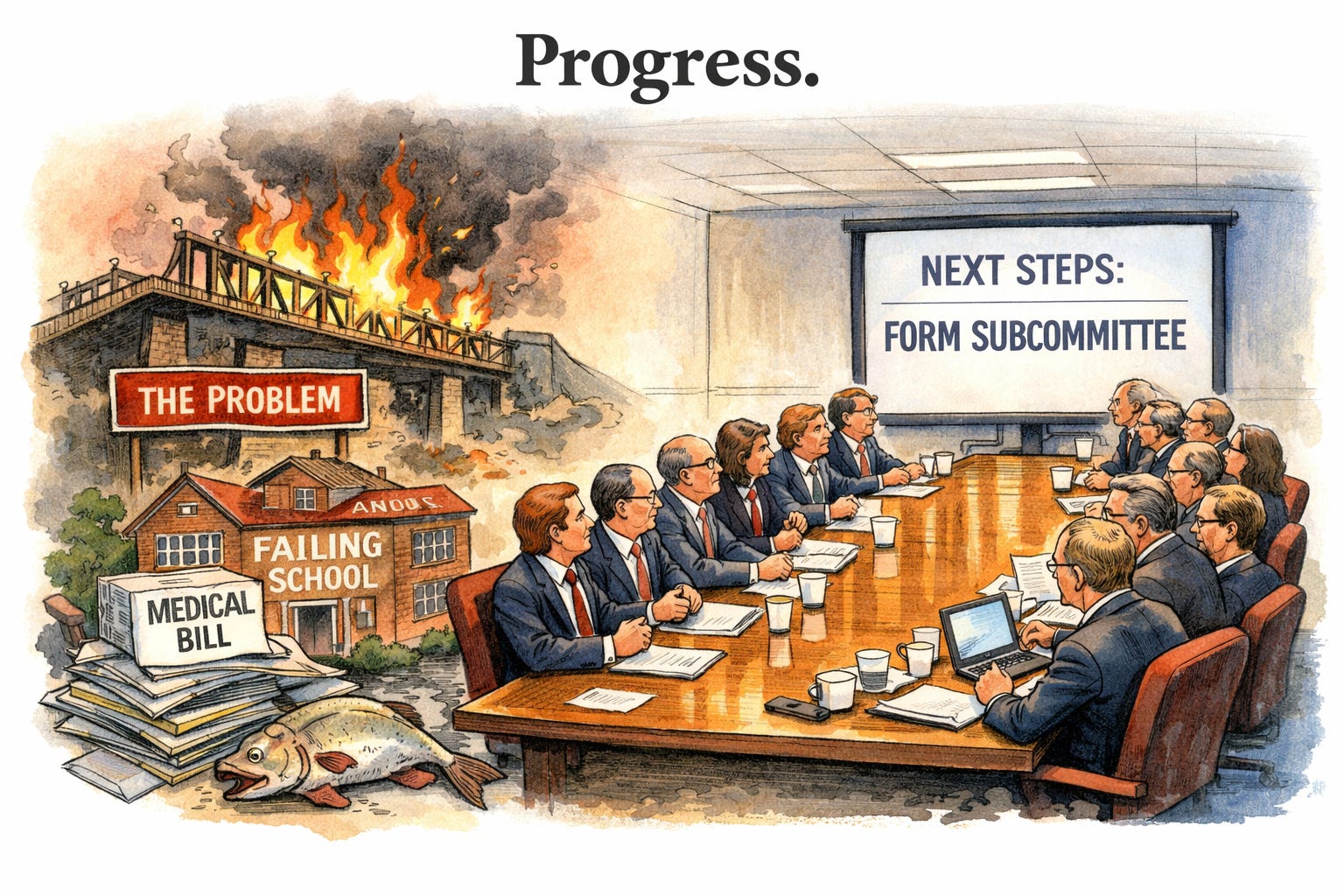
You call an agency. Press 1. Then 3. Then 4.
You wait.
If you’re lucky, you eventually explain the issue to a polite representative who explains that it must transferred to somebody else. Which means you may connect to a higher level of bureaucracy (not necessarily more intelligent).
And then, of course, you wait some more.
You eventually hang up after an hour, maybe with a reference number.
Thereafter, nothing happens.
That’s when suspicion creeps in: Maybe the system isn’t failing. Maybe it’s functioning exactly as designed.
There is a class in America that does not build bridges, repair engines, land planes, or grow food.
It manages, coordinates, oversees, evaluates.
Meet The Process Class.
No doubt, you already have, not by name, but through frustration.
Its survival depends on continuation.
If a problem gets solved, the funding ends. So guess what never ends?
Take salmon mitigation in the Pacific Northwest. Billions spent to offset the damage dams caused to fish runs. Task forces formed. Environmental reviews commissioned. Consultants hired to advise consultants.
The fish continue declining as the mitigation ecosystem thrives. Funded with a big budget that increases each year.
Or California’s high-speed rail. Years of planning. Land acquisitions. Community listening sessions. Environmental impact statements the size of encyclopedias.
And still no train from Los Angeles to San Francisco. And never will be.
Uh, how about Merced to Bakersfield?
No? How about Fresno to Visalia?
Probably not even that.
Meanwhile, the project hums along beautifully, wasting tax dollars (your money).
You don’t need a finished railway to justify a rail authority.
You need an expendable timeline.
Healthcare?
Ask a hospital what a procedure costs.
You will encounter billing specialists and compliance officers. A class of administrators expanding faster than physicians who actually treat patients.
Transparency is discussed to satiate media enquiries. But opacity remains.
Public Education?
We now spend more per pupil than almost any time in history. Administrative staff has grown dramatically over the past few decades, outnumbering teachers. District offices. Curriculum coordinators. Equity directors, assessment strategists, behavioral consultants, instructional facilitators.
Meanwhile, literacy and math proficiency sink to new lows.
Ask a simple question: “Can my child read at grade level?”
What you get is a presentation on holistic growth metrics.
No district ever announces: “We have achieved educational excellence. We are dissolving three administrative layers.”
Instead, we get strategic plans to appoint extra superintendents, which produces more process, not an elevation in education.
If reading and math scores fall, we commission a study.
The bureaucracy thickens.
⁂
You’ll find the Process Class inside federal agencies and corporate headquarters, in NGOs and university administrations, in environmental organizations and defense departments.
They transcend party and politics.
The Process Class is rewarded not for ending problems.
It bis rewarded for managing them. And, more important, perpetuating them.
When results are thin (always), they produce reports.
If progress stalls, they form a working group.
If criticism mounts, they announce a review.
Process is sovereign, outcomes merely decorative.
The average citizen senses something is off-kilter.
The danger isn’t tyranny.
It’s sediment.