

WHAT
This is about salmon.
More precisely, it’s about the permanent, taxpayer-funded failure to restore salmon runs in the Columbia–Snake River system—despite decades of study, regulation, and billions spent in the name of “mitigation.”
The fish keep disappearing. The money keeps flowing.
WHO
At the center sits the Bonneville Power Administration, operator, funder, and perpetual apologizer for a dam system that everyone knew—before it was built—would devastate anadromous fish and tribal fisheries.
Surrounding BPA is a dense ecosystem of federal and state agencies, government scientists and contractors, consultants, NGOs, and mitigation vendors, subsidized barge operators, and regulatory bodies whose job is to regulate without resolving
This is a case of institutional dependency.
WHERE
The Columbia River Basin, with special attention to the Lower Snake River, where four additional dams were stacked onto an already stressed system during the dam-building era.
These four dams—useful on paper, marginal in reality—turned a survivable obstacle course into a biological meat grinder.
WHEN
The problem began the moment planners decided to build dams and promise the tribes that fish runs would somehow be protected afterward.
Instead of choosing, they invented mitigation.
We’ve been “studying” the same problem for decades.
WHY
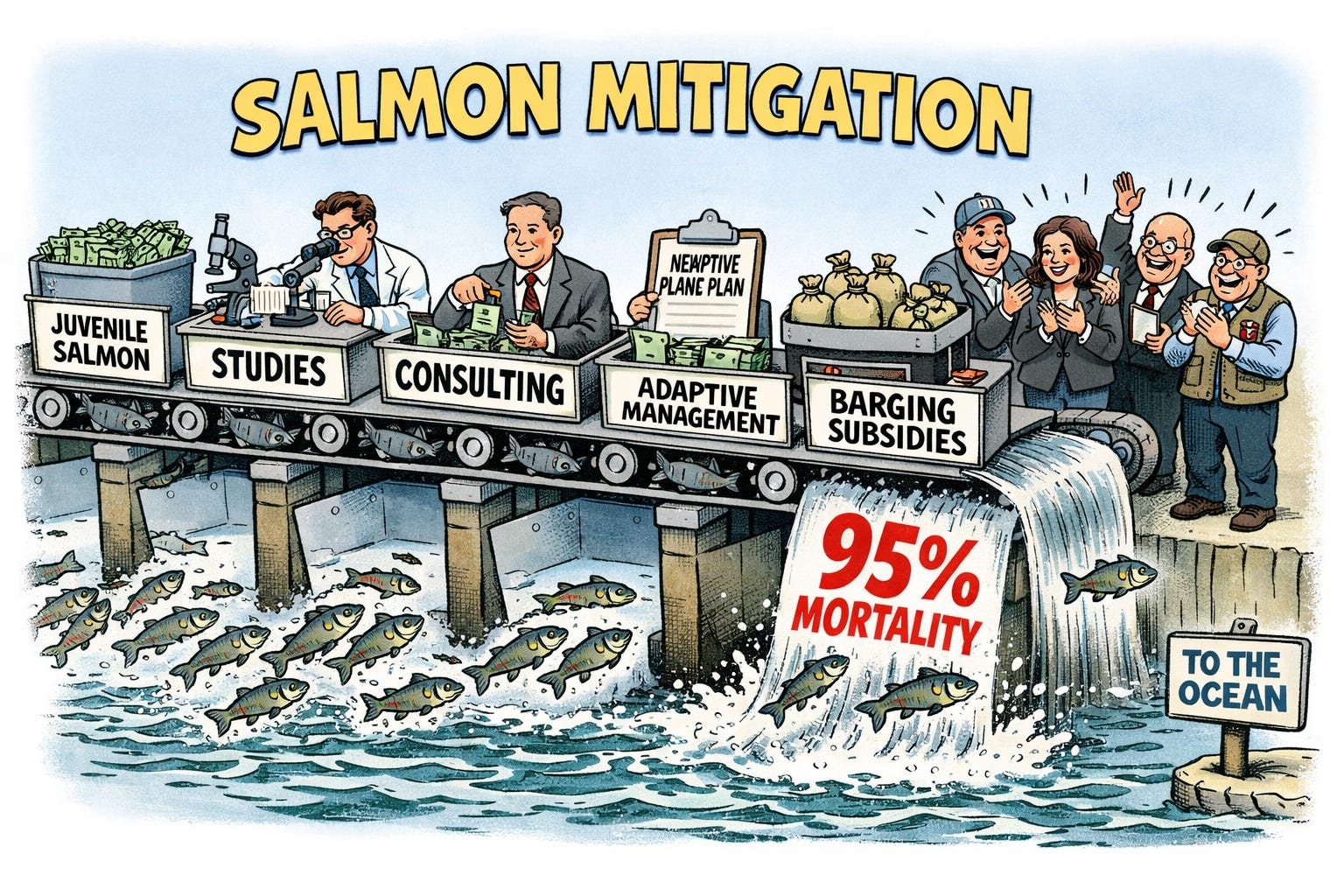
Here’s the dirty secret nobody puts in an executive summary: Juvenile salmon can survive four major dams. They cannot survive eight. The out-migration mortality rate is roughly 95%.
This is not controversial biology. It’s arithmetic.
Remove or mothball the four Lower Snake River dams, and survival improves dramatically.
Keep them, and no amount of habitat tinkering upstream matters.
But solving the problem would end a multi-billion-dollar mitigation economy, render decades of “adaptive management” obsolete, eliminate subsidized barging, shrink agency budgets, and force officials to admit the answer was obvious all along.
So instead, we manage decline.
Again, it’s all about process not solution.
HOW
By pretending complexity where none exists.
Mitigation becomes an industry: fish ladders, barging programs, tagging, tracking, modeling, endless reports concluding “more study is needed”
Each program creates jobs. Each failure justifies the next funding round.
Meanwhile, the four Lower Snake River dams—largely earthen, relatively easy to remove or mothball—remain untouched, despite quiet acknowledgment from insiders that their benefits are minor and replaceable.
This is not environmental stewardship. It’s regulatory theater.
BOTTOM LINE
The salmon problem is unsolvable under the current incentive structure.
But so long as process (read: failure) keeps agencies funded nothing fundamental will change.
Which is why this belongs in the same category as California’s “train to nowhere” and every other government program where admitting the obvious is economically disruptive to government bureaucracy (and the favorable contractors it supports).
When the gov't gets involved it appears to get very fishy !!