

There are choke points in every system.
Washington has committees. Intelligence agencies have oversight boards. Airports have TSA.
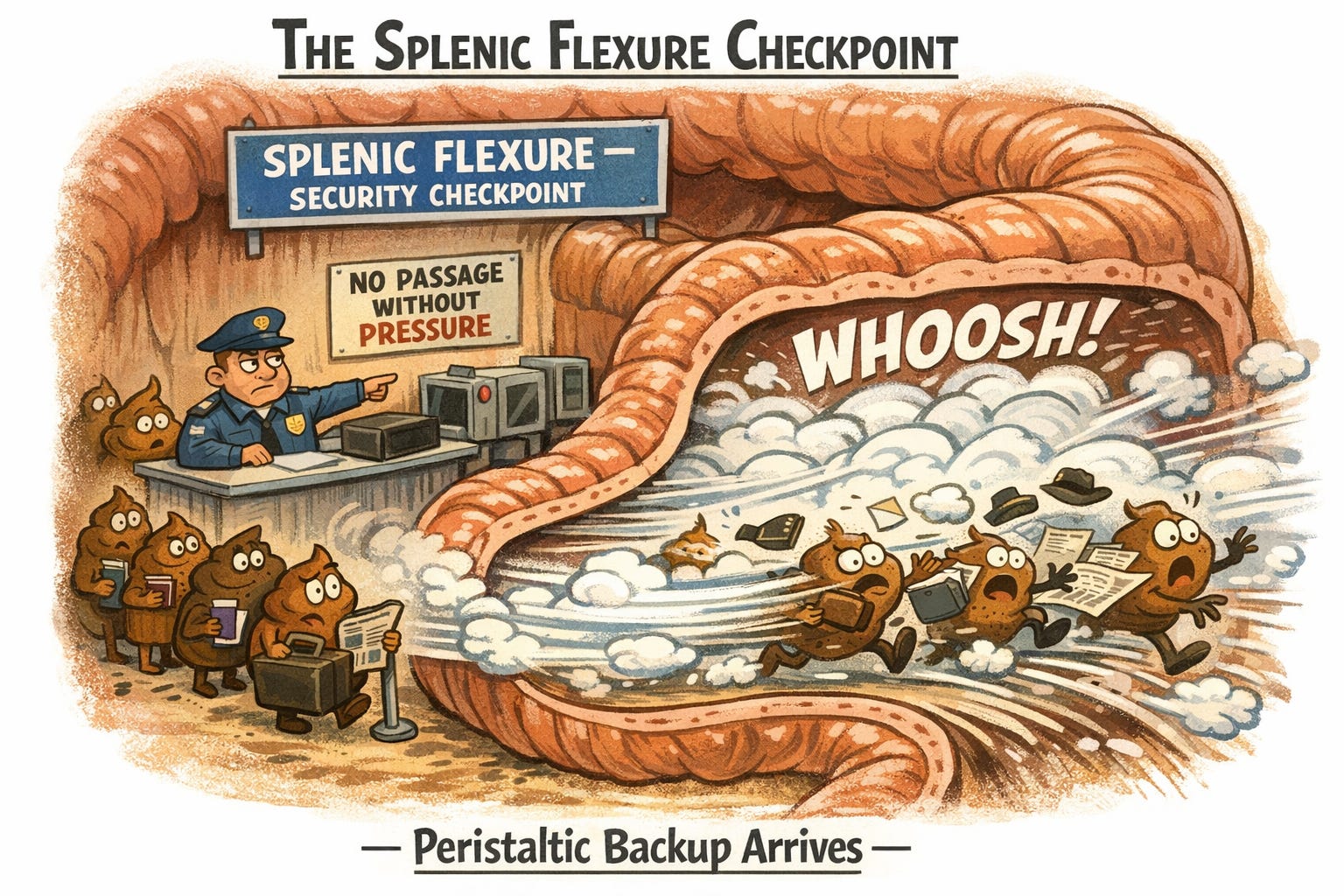
And the human digestive tract—nature’s original bureaucracy—has the splenic flexure, a hard left turn in the colon where progress slows, stalls, and occasionally files for indefinite delay.
It is here that things… linger.
Medical professionals describe the splenic flexure in neutral terms: “an anatomical bend between the transverse and descending colon.”
Translation: a traffic jam with no visible detour.
Long dismissed as an embarrassment—something to be suppressed, silenced, or blamed on upholstery—flatulence has suffered from a catastrophic branding problem.
What polite society fails to grasp is that gas is not a social error. It is a mechanism of momentum. A kind of internal enforcement arm. A nudge from within. A reminder to the system that stagnation is unacceptable.
Think of it as peristaltic backup. A pressure-assisted intervention.
Because when things reach the splenic flexure and simply sit there—hesitating, negotiating, considering options—flatulence arrives like a mid-level operative with clearance to move things along.
Firmly. Decisively.
The greater the pressure, the greater the likelihood that the impasse resolves itself. Not diplomatically. Not gradually. But with the kind of efficiency rarely seen in government or modern infrastructure.
And yet, we are told to suppress it.
Suppression has consequences.
Pressure denied is pressure deferred.
And deferred pressure, as any student of geopolitics—or digestion—knows, does not disappear. It accumulates. It waits. It builds toward a moment of undeniable expression.
Usually at the worst possible time.
So, perhaps it is time to rethink our position.
Perhaps flatulence is not the problem.
Perhaps it is the solution.
A natural corrective. A built-in failsafe. An occasionally audible guardian of forward progress.
And, most importantly, at the splenic flexure—where history shows that without a shove… the system clogs to a standstill.
P.S…