

There’s a temptation, when a case goes public, to imagine sophistication. Dark SUVs. Desert hideouts. Long drives into nowhere.
That is almost always wrong.
Strip the noise away and what remains is usually smaller, closer, messier—and far more ordinary.
The timeline matters
At 9:48 p.m., the garage door closes. She is home.
At 1:47 a.m., the doorbell camera disconnects.
At 2:12 a.m., the system logs a person at the door—no video, just presence.
At 2:28 a.m., her pacemaker stops communicating with her phone.
That sequence is not chaos. It’s compression. A narrow window measured in minutes.
If we assume the most banal version of events—a pair of low-level burglars inside a suburban home, startled awake by a homeowner who was never meant to be part of the night—then the crime doesn’t begin as kidnapping. It mutates into it.
Panic ensues.
Burglars plan for absence. When absence fails, improvisation takes over. And only later—after the adrenaline drains and reality sets in—does the idea of demanding a ransom take shape.
The two-day delay before a ransom demand is telling. Professionals don’t wait to establish leverage. Amateurs do—because they’re trying to stabilize what they didn’t intend to create.
Crimes born of panic behave differently than crimes born of planning.
They stay close.
Not because close is clever, but because close is familiar. Close is controllable. Close doesn’t require highways, gas stations, or explanations. Close means the offender doesn’t have to think—just contain.
In these scenarios, victims are not taken to “hideouts.” They’re taken to places that already exist in the offender’s life: a house they know, a garage they control, a secondary structure no one pays attention to. Sometimes it’s their own. Sometimes it belongs to an associate who asks fewer questions than they should. Almost never is it remote desert or cinematic isolation. Those places feel anonymous until you’re actually there—and then they’re exposure nightmares.
The timing reinforces this. An early-morning removal favors local knowledge and low visibility. A ransom demand delayed by 48 hours signals stabilization, not transport. The offender wasn’t moving during that time. They were figuring out how to breathe.
This is the uncomfortable truth of most ransom cases that don’t look “professional”: the radius shrinks, not expands. Distance is risk. Logistics are risk. Silence paired with proximity is not clever—it’s fearful.
Where Authorities Should Be Focusing Their Efforts
If this is a panic-born crime—and the timing and behavior suggest it is—the pattern points local.
When removal happens between roughly 1:45 and 2:30 a.m., and a ransom demand doesn’t materialize until about 48 hours later, the statistical center of gravity collapses toward the offender’s anchor point—the place they already know, already control, and already feel safe enough to sit still in.
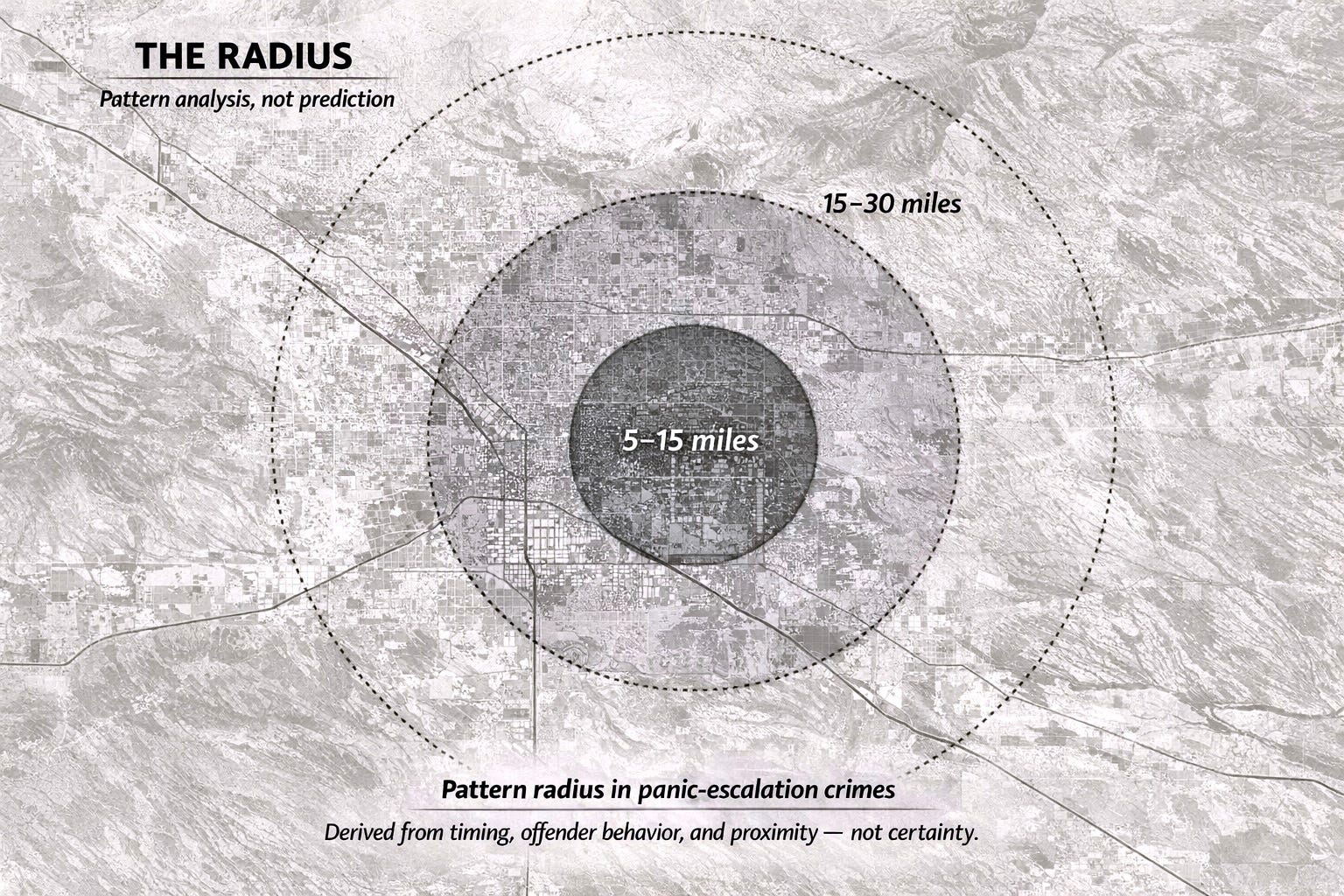
That puts the most likely holding radius within roughly five to 15 miles of the abduction site.
Out to 15 to 30 miles remains plausible if the offender has a known secondary location or an accommodating associate. Past 30 miles, absent evidence of early highway movement or structured planning, distance becomes exposure rather than protection.
Start with who had reason to be inside that house at that hour without a plan for what came next. Burglars don’t materialize randomly. They observe. They select. They return.
That means attention belongs on recent, local property crimes—especially the unsophisticated ones. The kind marked by hesitation, aborted attempts, or sloppy execution.
From there, follow social gravity, not geography. Low-level offenders rarely operate alone, and they rarely keep secrets well. They borrow vehicles. They lean on friends. They show up unannounced. Someone else always knows more than they should.
Focus on ordinary spaces inside that five-to-15-mile band: garages that suddenly stay shut, backyard structures that gain an unexplained occupant, properties where routines shift just enough to register if you’re paying attention.
Digital behavior should be read the same way. Panic doesn’t produce silence—it produces noise. Late-night phone activity. Clumsy searches. The ransom message itself—its tone, pacing, and lack of polish—is not just a demand.
Experienced investigators read ransom messages less as demands and more as psychological documents, to understand where the writer is stuck.
The ransom message in this instance doesn’t project control; it circles the moment of loss. Clothing. Objects. Memory fragments still warm from contact. That isn’t the language of distance or design. It’s the language of someone who hasn’t moved on—mentally or physically.
Cognitive movement usually tracks physical movement. Psychologically, they haven’t advanced to the next phase. People who transport victims long distances tend to shift language accordingly—toward control, logistics, pacing. People who stay are looping close to origin.
Interesting analysis.
Makes clear sense.
It also as I read it means Mrs. Guthrie is in serious trouble. If for no other reason they do not have the means to cover her medical needs.
Thanks
I’m going dark on this one…
Five years ago, Savannah Guthrie embarrassed the f*ck out of Trump during a Townhall… all the while “projecting” about pedophiles (because he himself is one).
Fast forward to today…There is a $6 million BITCOIN ransom for her mother; while he lies publicly that he likes Savannah and has always gotten along with her. 🙄
https://youtu.be/Znypy6knxiQ?si=EWGj24g5EjSL_WKs
And there’s more…
NBC has mysteriously taken down interviews Savannah Guthrie did with the Epstein Survivors, most notably Virginia Giuffre, who stated she was sex trafficked from Mar-a-Lago.
https://substack.com/@redactedreport/note/p-187045677
Trump’s ass has something to do with this kidnapping…allegedly.